 |
| Coming Soon: Southwest Chief Adventure! |
Sunday, February 21, 2016
What's Been Happening Around Dunes Junction


Tuesday, September 15, 2015
First Rides Behind an ACS-64 City Sprinter
 |
| Did an up-and-back trip from Washington, DC to Stamford, CT over the weekend, and this ACS-64 was on the point. It was a smooth and uneventful ride, and my first ever ride behind a City Sprinter |
 |
| Northbound Acela approaches Stamford while waiting for the train to take us home. Dig those tangles of track and catenary! |
 |
| And this ACS-64 got us home, on time and without incident. These locos are growing on me . . . Kato announced one in N scale, maybe an HO version isn't far behind |
Monday, September 7, 2015
Sighted During a DC Brewery Hike: Amtrak's Ivy City Facility
 |
| My wife Rachel and set out on a little urban hike in Washington DC's Ivy City neighborhood to find craft beer and fancy food. Our route took us on an overpass spanning Amtrak's Ivy City facility. Here are two Acelas warming up for runs up the Northeast Corridor later in the afternoon. |
 |
| The whole facility, early in the afternoon. By late afternoon, this staging yard was full of Acelas as well as other trains destined for the NEC and points west. |
 |
| A switcher pushes Amfleet cars into the shops while Acelas await their runs north. |
 |
| More of the staging yard. Note the Superliner cars between the two Acelas on the right. |
 |
| Another view of the staging yard. |
 |
| Northbound Acela on the main line passes the Ivy City facility. |
Saturday, August 15, 2015
More Reporting From the Road, Including Photographic Evidence
My road warrior summer continues, and I've been all over the south east with my new work responsibilities.
But still, the trains, I cross paths with them. I even found some energized overhead wire! Woo hoo!
But still, the trains, I cross paths with them. I even found some energized overhead wire! Woo hoo!
 |
| Yours truly at Railroad Park in Birmingham, Alabama, photo courtesy of my wife. Birmingham has become my alternate base of operations. |
 |
| Meet in front of the tower near Sloss Furnaces in Birmingham. This is truly a 'hot spot', with many trains from Norfolk Southern, CSX, and Kansas City Southern moving through. |
 |
| The Sloss Furnaces visitor center is nestled in the actual junction trackage. Here's a view to east/south east . . . |
 |
| . . . and a view west as the junction track curves to the north |
 |
| Outside of Sloss Furnaces also looking west. |
 |
| If there is energized wire, I will find it or it will find me. Was doing executive nonsense in the executive lounge of the Hilton in Charlotte, North Carolina, when I looked up and caught this view of the light rail. |
 |
| More of the Charlotte city vista, with another light rail train passing through. |
Monday, June 8, 2015
On the Road Again . . .
Sorry for the paucity of posts over the past month or so, but my work has put me back on to the road again. The good news: my projects and my team are growing, and I'm lucky to have an awesome team with whom it is a pleasure to work and travel. Unfortunately, being on the road with a growing and active work project leaves me with precious little time for my railroadly pursuits.
But I'm getting by! I couple of weeks ago I managed to sneak in a trip up to Philly for the East Penn Traction meet . . .
But I'm getting by! I couple of weeks ago I managed to sneak in a trip up to Philly for the East Penn Traction meet . . .
 |
| . . . which involved a Toaster-driven ride up to Philly on Amtrak. . . |
 |
| . . . and seeing the modeling handiwork of and hanging out with Bill Bolton, Australian gentleman and regular on Facebook traction groups . . . |
 |
| . . . as well as a-building heavy electric modules. |
Friday, May 8, 2015
American Electrics: South Shore 700-Class Boxcab
 |
| "19660529 09 South Shore Line 703 @ Michigan City Shops" by David Wilson - Flickr: 19660529 09 South Shore Line #703 @ Michigan City Shops. Licensed under CC BY 2.0 via Wikimedia Commons. |
The 700s were the other hand-me-down freight engines in the final years of electric freight operations on the South Shore. They began life on the New York Central as R-2s, where they drew power from 660VDC third rail in the tunnels and suburban lines around New York City. Diesels were able to work the tunnels in NY, thus saving the NYC time and money by eliminating the need for engine changes. South Shore picked up seven R-2s between 1955 and 1967, added pantographs, changed other carbody appurtenances, and rewired them for 1500VDC operations.
 |
| Nickel Plate Products CSS&SB 700 in HO. |
Nickel Plate Products imported a Japanese model of the 700 in brass in HO during the mid 1970s. It is a notoriously bad runner with a tendency to crack its gears. Its minimum track radius of 22" is somewhat surprising, given the model's short overall length and wheelbase. The pantographs are also typical 1970s fare--not intended to actually contact wire, barely stay retracted/folded, and look not quite right. The small 'footprint' of pantographs may necessitate actually scratchbuilding replacements. Still, it's a beautiful, chunky model with a lot of butch, gnarly detail. I have one in my collection, and I plan to eventually re-work its drive, install DCC and lighting, and paint it. Maybe another will come along to join the Dunes Junction roster.
Friday, May 1, 2015
Pantograph Mounts for Old-Style South Shore Coaches
 |
| Evergreen styrene strips, rod, and square tubing, plus some insulators from the scrap box make up the mounts for the ConCor pantographs. |
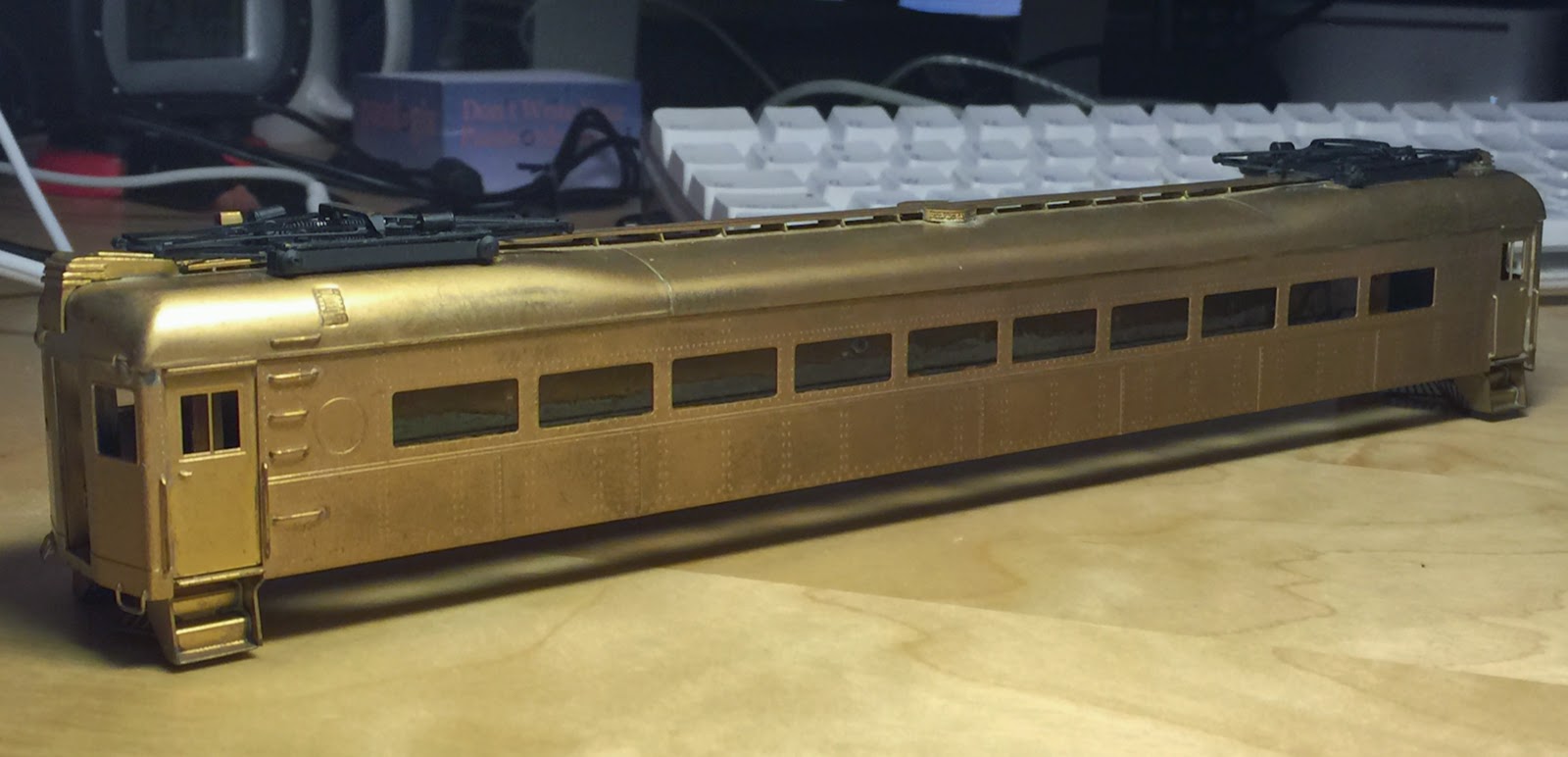 |
| The whole shebang, ready to be place back on its floor. |
Tuesday, April 28, 2015
Marty Bernard's Treasure Trove of South Shore Photos
The "Chicago, South Shore & South Bend; The Last Interurban" group on Facebook is a favorite part of my Facebook feed, always providing nuggets of South Shore goodness amidst the cat pictures and memes.
Marty Bernard is frequent contributor to this Facebook South Shore group, posting his original South Shore images from the 60s through 80s. He recently posted a link to his Flickr gallery, which has two albums of his original South Shore photos. South Shore fans and modelers owe Marty a debt of gratitude for making these pictures available.
Friday, April 24, 2015
Surfacing Primer on the IHP Nippon Sharyo Car
 |
| The IHP Nippon Sharyo Body with a light coat of Tamiya Surfacing Primer. This will help show flaws that need filling and correction; will let it dry for a week or so. Body details such as grab irons, bells, and ditch lights go on after any corrective action, and body will get another coat of primer. |
Tuesday, April 21, 2015
The International House of Pantographs
 |
| International House of Pantographs: If you spend enough time around HO heavy electrics, you might end up with a motley crew of pantographs like this. Most of these are Sommerfeldts from Germany but there're others in there, salvaged from old heavy electric models or acquired outright for various projects. Modern single-arms tend to look okay for North American prototype models, but some of those old-fashioned diamonds on the right side of the picture really look foreign. |
 |
| Must look good folded: this is a modified Con-Cor MP54 pantograph. These are swell-looking pantographs, in either the up or down position. The photo-etched arms are especially well-done. The very well detailed base, which is very accurate for the MP54, has been removed via a very scary unsoldering process. The insulator and bottom support beams are lovely and large lost wax brass castings that absorbed all the heat my best 60-watt soldering iron could produce, thus a very uncontrollable and imprecise process. I've since acquired a resistance soldering rig for 'next time'. Will now fabricate a new base and insulators to complete the South Shore look. Did I mention it looks good folded? |
 |
| One up and one down. New bases will be fabricated from styrene, or of I'm feeling frisky, from brass. |
Friday, April 17, 2015
Freelanced S Scale Electrics: Dick Karnes' New York, Westchester & Boston
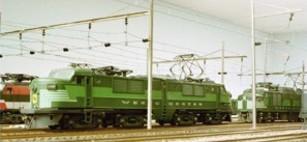 |
| Photo courtesy of Model Memories |
Dick's locomotive fleet is particularly intriguing to me. He has prototype electric locomotives, but also a number of freelanced electrics. Dick modestly describes his freelanced electrics as "plausible"--but to my eye they blend a keen eye for the lines and the technology of 1940s and 50s era and excellent modeling. The NYW&B's electrics indeed look like they belong among EP5s, EL-3As, W1s, E2Bs, E2Cs, E3Bs, and other streamlined electrics of the postwar era.
As noted here previously, freelanced railroads and models seem to be somewhat out of fashion of late. But as I think back on some of my favorite formative model railroading influences--Bob Hegge's Crooked Mountain Lines, Bruce Goehmann's Midland Electric, Eric Brooman's Utah Belt, Tony Koester's Allegheny Midland, and many others--I realize that freelanced railroads and models are a big part of my model railroad outlook. Dick's work just reminds me that smart freelance modeling is still alive and, well, and cooler than ever.
Tuesday, April 14, 2015
Some Dude Built His Own Version of a Model Railroader Project Railroad and It's Awesome
 |
The NYC/PC Hitop Branch layout, courtesy of Steve Campbell.
Wait'll you see the close ups! |
What caught my eye was the MRH blog headline, "Originally MR's "The Virginian " build"--I always wonder about the lives of track plans and project railroads from the big model railroad magazines.
Naturally, I clicked through and was treated to Steve's inspired rendition of Model Railroader's Virginian 4x8 project layout from several years ago.
Steve kept the Virginian track plan but changed the prototype and the era to a New York Central branch during the Penn Central transition era. Click through the links to see excellent vignettes of beautifully weathered rolling stock against a backdrop of convincing scenery and structures. The overall effect is an improvement on MR's Virginian, and a rare example of a state-of-the-art small layout. The result is some truly inspirational and exciting model railroading.
If I sound a little overexcited about the Hitop, it's only because awesome small layouts seem to get so little attention in the mainstream model railroad press. There are a lot of ways to do model railroading, but sometimes the big magazines make it seem like prototype-focused basement-sized empires and large operating sessions by schedules and train orders are the only, normal way to be in the hobby.
The conspiratorially minded among us make a compelling argument that big, sprawling layout stories with their attendant gigantic rolling stock fleets, miles of track, and complex arrays of DCC and sound gear and overpriced switch machines are favored by model railroad magazine advertisers (Tom Barbelet lays it out in this Modeler's Life interview), and that's why little shelf layouts and 4x8s don't get more attention. To be fair, I think there is an element of self selection in the mix as well--serious model railroaders probably do tend to build bigger layouts. But Barbelet is on to something: it's kind of hard to believe that the magazines can find a couple of dozen or so room- or basement-sized layouts per year for feature stories, but only a few story-worthy shelf layouts or 4x8s.
(The 4x8 project layout I've always wanted to see is Wingate, Indiana as featured in "Small-town railroading, Midwest style" in the first ever MR's Model Railroad Planning annual back in 1995. Staging behind a backdrop, and a modest bit of switching of 50's-era light industry. I'd like to see it built up, populated with state of the art modeling, and then watch an operating session)
Anyway, I'm delighted to have come across Steve Campbell and the Hitop. I'm looking forward to seeing more of his work and hope my small layout can eventually capture a look, a time, and a place as well as his Hitop Branch.
Friday, April 10, 2015
Further Notes on Brass Remotoring and Customer Service
 |
| Hollywood Foundries Bull Ant drive and TCS KAT22 decoder fitted to floor of NPP South Shore Combine |
Hollywood Foundries serves up the Bull Ant in a nearly infinite number of combinations of mounts, wheel size, wheel profile, wheelbase, gauge, motor size, and wiring. The Bull Ant is an above-the-floor design that uses Mashima can motors.
Hollywood Foundries is run by Geoff Baxter amd is located in Australia, but don't let the distance fool you. The Hollywood web site has an exemplary interface for ordering the customizable Bull Ant and other products, and the e-commerce transaction is a breeze. Geoff is extremely helpful and responsive if you have any questions or concerns about Hollywood's products or your order. My drive took about three weeks to arrive, and Geoff was extremely accommodating about a last minute change to my order.
My initial attraction to the Bull Ant was that it has a flywheel and decent-sized motor, and is also very ruggedly engineered. Also, the mounting appeared to be somewhat more elegant than the raised floor mounts required by the NWSL Stanton Drive.
I ordered mine with a 37mm 'end mount'; technically, it's probably a cantilever. Mounting was very simple: I located and drilled two 2mm holes in the in the center sill of of the car and the Bull Ant's nickel silver end mount and used the included 2mm screws and nuts to fasten to the drive to the floor. A bit of .030" styrene sheet between the end mount and the car floor ensured that the car sat level.
After following Hollywood's run-in instructions, I attached the truck sideframes to the Bull Ant with epoxy. Next time, I will use styrene blocks to build out the Bull Ant's sideframe mounting surface to give the sideframe more mounting surface.
A TCS KAT22 decoder was wired in and programmed.
In comparison to my Stanton-equipped NPP cars, the Bull Ant-equipped South Shore car is noticeably noiser, owing to the gears and location of the larger motor. Side-by-side with the Stanton, the performance is comparable, save for the gear noise of the Bull Ant. The flywheel does impart some smoothness to starts and stops, but it's so small that it does not help the model glide through dead frogs or dirty track, the way old All-Nation and Hobbytown flywheel drives did back in the day.
Meanwhile, I had concerns about the performance I was getting from my earlier Stanton re-motoring projects. I had heard and seen that Stantons ran smoothly, but both of mine were troublesome. I posted some queries to a couple of the Yahoo traction groups, and got more confirmation that I should expect smooth performance from the Stantons. A proper break-in was miraculous for one of my Stantons, but the other had a hitch in its get-along.
During the discussion I initiated on the topic of Stanton Drives on the Yahoo forums, NWSL honcho Dave Rygmyr, the maker of Stanton Drives, joined the conversation. He invited anyone with a problem Stanton to contact him, so I did. He asked me to send him the troublesome Stanton, and it came back a week later, running flawlessly.
One of my TCS KAT22 decoders also developed a glitch, and TCS also promptly arranged to service and/or replace it.
TCS, Geoff at Hollywood, and Dave at NWSL are exemplars of customer service and quality manufacturing. It turns out they collaborate in real life--NWSL produces some components for Hollywood--so it's not surprising that they share a similar customer service orientation. They are also examples of old-school craftsmanship harnessing the power of the internet. I would never have been able to hear directly from Dave if not for internet forums, and Geoff and I would still be sending snail mail and dealing with international payment methods were it not for his excellent e-commerce interface.
All signs, I think, that model railroading is thriving in the 21st century.
Tuesday, April 7, 2015
Stamford Connecticut Action
We traveled up to my in-law's place in Connecticut this past weekend, and a railfanning highlight was an action-packed ten minutes in Stamford.
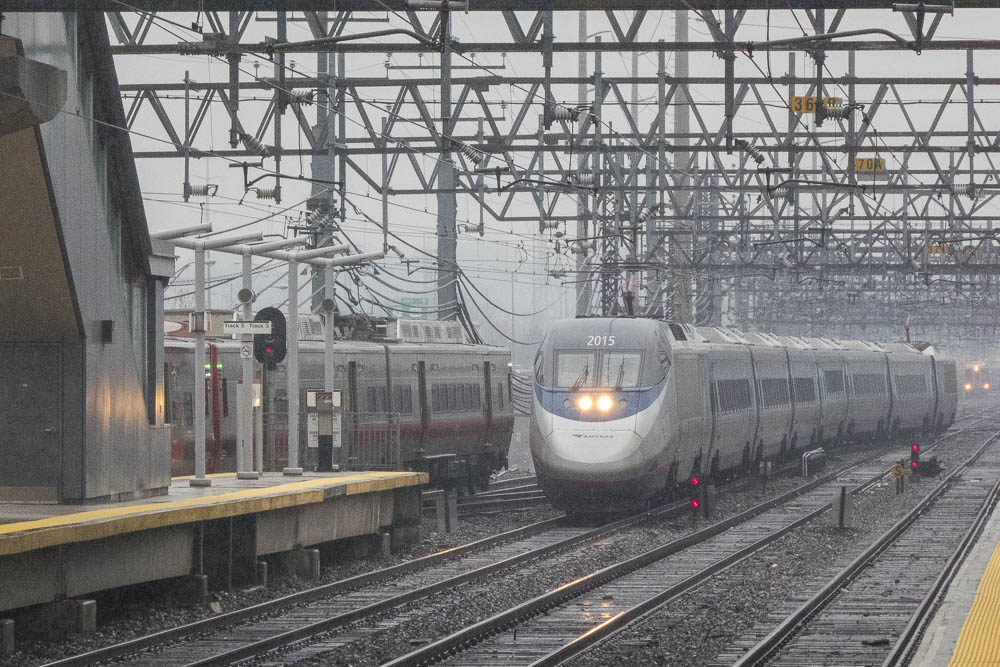 |
| Acela meets a Metro North train at Stamford on 3 April 2015, with another Metro North train in queue in the distance. |
 |
| Metro North train departs Stamford. |
Friday, April 3, 2015
Dunes Junction Track Plan Updated
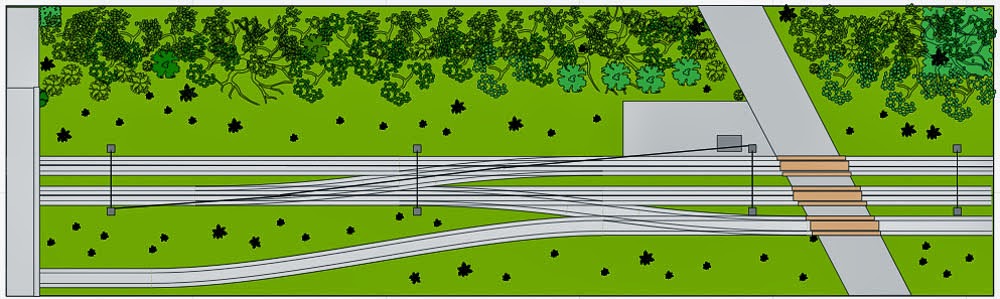 |
| The current Dunes Junction track plan, rendered using RailModeller and RailModeller Pro. |
Subscribe to:
Posts (Atom)