Monday, October 8, 2018

The Best Camera is...


BNSF action: a transfer move overtakes a unit train near Denver Union Station.
...the camera you have with you, which applies to railfan photography as much as it does 'normal' photography. My trusty iPhone is the camera I have with me most often, and I've managed some remarkably good catches over the past year or so during travel and around my home area here in suburban Washington.

Admittedly, the iPhone camera is limited in functionality compared to a fully-featured camera. But it also has some intriguing low light features, including High Dynamic Range (HDR) capabilities that allow quality photography under a variety of adverse lighting conditions. This capability--in combination with the the fact that it is usually immediately accessible and available--make for exciting photo opportunities. I have found that those limited features force a focus (see what I did there?) on fundamentals of composition and planning.

A CSX unit train idles, awaiting orders to move out of Nashville's 'Gulch' at Kane Avenue tower on a rainy Saturday in early September 2018.

Denver's RTD Light Rail at Union Staion


RTD Heavy Rail Service, which serves Denver's distant and sprawling airport as well the northwest 'burbs.

Another view of BNSF action in downtown Denver near Union Station.


Closer to home, a brand new Siemens Charger diesel pushes a commuter train into Washington DC at Garrett Park, MD

Cab of an inbound MARC train, also in Garrett Park.

A more 'normal' MARC MP36PH-3C pulling a train into Garrett Park.
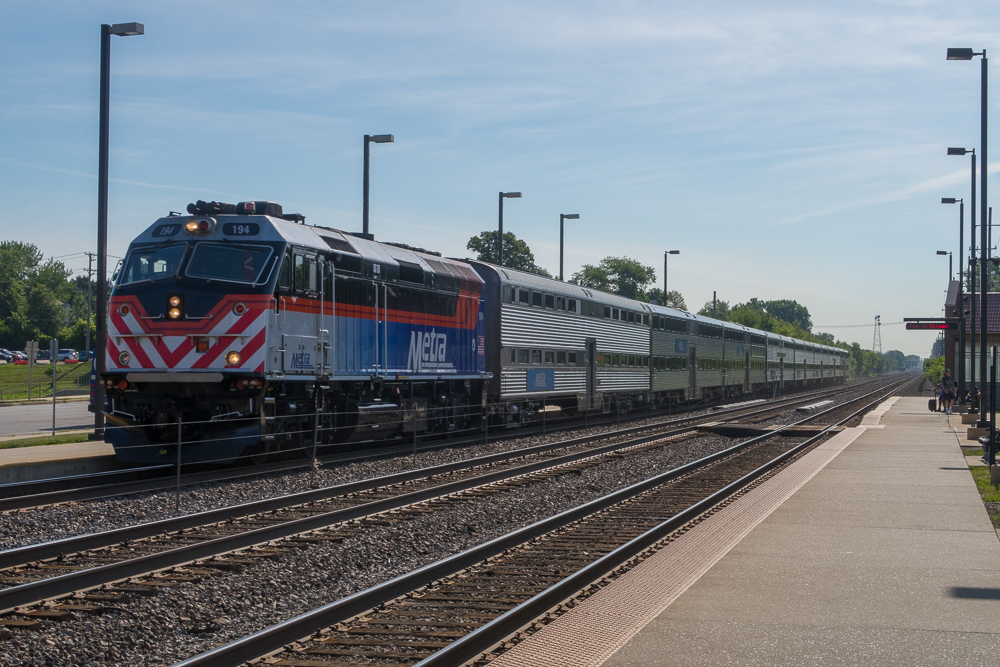
We travel frequently to Connecticut and ride Metro North from New York City to Danbury area. Here are Metro North M9 electric MUs in Stamford, Connecticut. 
This bit of Metro North is the former New Haven line into Danbury, which was once electrified (holla!) and still has many of the old catenary towers in place. Nowadays diesels do the work, like this rebuilt diesel sporting the modern take on classic McGinness New Haven paint scheme.

Monday, October 1, 2018

Calumet Region N Scale Models: The Long View

On the bench: Island Model Works/Shapeways South Shore/NICTD Nippon Sharyo body shell (buy it here). A quick test shows it will fit on the Kato RDC drive with a bit of of judicious filing and fiddling. Will need some Faively-style pantographs and some decal-bashing in addition to silver paint and window glazing.
N scale models of prototypes from my home area--the Calumet Region of Northwest Indiana--keep turning up, and I keep adding them to my rolling stock roster.

Walthers updated and re-ran its N SW1200 earlier this year, and offered it in two different Calumet Region paint schemes: Indiana Harbor Belt and Elgin Joliet and Erie. I picked up the IHB version, and would pick up another road number and even the EJ&E version if one presented itself. The SW is a fine loco, but its DCC decoder installation is quite fussy owing to very tricky disassembly that can result in mangling vital pickup wipers. The IHB SW is an excellent complement to Bluford's IHB transfer caboose, two of which I also acquired.


Another N surprise turned up on the Island Model Works store on Shapeways, which is a South Shore/NICTD Nippon Sharyo coach shell. The actual Shapeways item is inexplicably called 'Nss Single 12-2016' but it is unmistakably a South Shore stainless steel coach. It appears to be scaled down from IMW's HO resin offering of this same car, construction of which has been covered here previously on Up Dunes Junction. A test fitting suggests the shell will fit with some fiddling and grinding over the Kato RDC drive. In particular, the interior features posts that extend from the roof down to a few millimeters or so shy of the of side bottom, suggesting it would fit on to a conventional floor as on the IMW HO version of this car. To fit on the thick Kato RDC drive, these interior posts will need to be shortened by another few millimeters.
Bluford IHB transfer caboose and Walthers IHB SW1200. The decoder install in the SW is a tight, difficult fit, but it is a good runner, no small feat in such a small, light locomotive.
An unexpected treat showed up during a visit to the monstrous Caboose Hobbies during a business trip to Denver, the Grasselli Interlocking Tower produced by Region Specific Models. Grasselli was a typical Northern Indiana interlocking tower in East Chicago. It has since been relocated to the Hoosier Valley Railroad Museum in North Judson, Indiana, where it will be restored. This kit is made from laser-cut craft board, and will actually be pretty tiny when completed--but iconic for its typical Calumet region look.
The RSM Grasselli kit, based on an iconic Indiana prototype.
In addition to the pictured Calumet Region models, kits, and parts, I have been patiently awaiting the arrival of several Intermountain EJ&E SD38s. These non-turbocharged road switchers were a constant presence in my childhood hometown of Dyer, Indiana, where the EJ&E (now CN) crossed the old Monon (later L&N, Family Lines, and currently CSX), and the throaty drum roll of these normally-aspirated EMDs became the first locomotives I could recognize by their sound. Apparently, Intermountain's run of SD38s has been stalled in the latest episode of Model Railroad Industrial Complex drama, the abrupt closing of the Affa model train factory in China. Apparently the patriarch of the Affa company up and retired, leading to the closure of the factory, although rumors and speculation about trade wars, tariff hikes, and the like have been running rampant in internet-based forums. Nonetheless, Model Railroad Industrial Complex insiders at Con-Cor and Rapido have provided separate but consistent accounts of how the Affa closure came to pass, and have assured that the ecosystem of Chinese model railroad manufacturers will pick up the slack over the next year. In the meantime, I will patiently await my order of SD38s.

Readers may be wondering: don't I already have an HO South Shore layout?  The whole point of my N scale sojourn and Old Line Corridor has been modeling Northeast Corridor prototypes that have been impractical to cover in HO, so why all the fuss over N scale models of Calumet Region prototypes?

For the moment, my focus will remain on NEC prototypes in N and Calumet Region, including the South Shore--in HO. But I'm thinking ahead to my future model railroading, where I anticipate time and resources for model railroading but maybe somewhat less space or more transitory space. My spouse and I are eyeballing our possible (retired) future without a large house--or even living between multiple smaller houses.

In other words, a portable, space-conscious approach to model railroading is likely to be in my future, perhaps even modular model railroading using the T-Trak, N-Trak, or Free-Mo standard. The modular approach would give me an opportunity to build some Calumet Region layout design elements, and provide an appropriate venue for running Calumet Region equipment.

Fortunately, I live in prime N scale module territory: our excellent local Northern Virginia NTrak (NVNTrak) club has both NTrak and T-Trak divisions. I'm looking forward to getting to know the  NVNTrak gang in the future, and modeling my favorite Calumet Region railroads.


Monday, September 24, 2018

Mind the (Background) Gap

The source photo, before extensive
Photoshop-pery to blend it in.
When I visited the Northwest Indiana area--known in those parts as 'The Region'--I had several high priority to-do items, including eating some Aurelio's pizza and finally photographing the Mineral Springs crossing. I needed a good shot down Mineral Springs Road in the direction of Lake Michigan to fill the gap in the HO Dunes Junction backdrop. The appearance of oblivion elicits comment from everyone who visits the layout, and I have wanted to remediate this unsightly gap for the five or six years the backdrop and scenery have been in place. After some trial and error, I got the photo where it needed to be with Photoshop and numerous tries at the printer.
Before: that oblivion look. Is that the end of the world? Or just a high cliff overlooking Lake Michigan? Many visitors to
the layout—my father-in-law in particular—immediately call attention to this gaping sight.

After: I cleaned up the photo and used Adobe Photoshop to transform the photo, primarily to match up the angle of the road and roughly match up the coloration of the road surface and vegetation. Still not perfect, but it makes the point and solves a pesky visual distraction on Dunes Junction.


Monday, September 17, 2018

Nashville

Quick! A train! I caught this CSX freight snaking out of Radnor Yard while we were conducting an impromptu craft beer crawl after a biscuit-heavy brunch in The Gulch neighborhood of Nashville.
My wife, Rachel's attendance at a rail industry trade show occasioned a visit to Nashville, Tennessee, recently. It was an immersion into the city's ample cultural offerings--food and drink everywhere, and there was country and pop music emanating from most doorways and even sewer grates--and on the side I managed to squeeze in more than my usual amount of collateral rail fanning.

The best camera is the one you have with you. After a busy and rainy morning of trade show logistics, I captured this image of a CSX coal unit train waiting at the historic Nashville L&N station with my iPhone. I bumped into another railfan in this same spot who turned out to be Brian Schmidt, a Trains magazine editor who was in town for the rail industry trade show.
A CSX intermodal train passes hip and trendy condos in the Gulch. Not visible to the right, my new railfanning pal Brian Schmidt cursing me for distracting him from his railfan photography with my irresistible conversation skills.

A GP38 road slug set knocking covered hoppers around the Gulch.

Get a load of this lovingly painted transition-era Louisville and Nashville Geep at the Tennessee Central museum.


Serious dudes trying to stay out of the way
of real railroad operations: Andy Elkins,
center, yours truly on the right,
Another of Tennessee Central's workhorses is this SW wearing early Illinois Central-inspired colors.
Day two of my visit to Nashville was full of intriguing surprises. Friend and colleague Andy Elkins--a fellow infrastructure protection professional--gave me the backstage tour of Nashville that included the Tennessee Central rail museum, barbecue restaurants, and cab ride on Nashville's budding commuter rail line, the Music City Star.
Ex-Amtrak F40PH #121 powered our Music City Star train.

Obligatory front-end view of F40PH #121.

The cab end approaches the Nashville station. The car's Chicago Metra heritage is
apparent in the colors and lines.

In this cab car view, our inbound train is in the hole for a meet with an outbound train.

Outbound view from the F40PH cab. Unlike many commuter rail lines, the Music City Star route is curvy, single track, and features many interesting bridges and scenic views.

Monday, September 10, 2018

Odds and Ends Around the Old Line Corridor

I originally built a Piko (also Con-Cor) substation for the OLC, but it just didn't have the distinctive lines or towering bulk of NEC substations. The maker of OLC's catenary towers, DesignDyne/Shapeways, produced this N scale substation. Look for an upcoming post on the substation. 

This kitbashed highway overpass was made from a couple of Rix overpass kits, with piers fabricated from Evergreen styrene strips. The overpass and the paper plant form a kind visual block to break up the curve at this end of the layout. Looking forward to scenicking the overpass and the paper plant into the layout.  

Designdyne/Shapeways four-track catenary bridges finally installed over the 'visible staging' yard. I wanted to run trains around the OLC and couldn't do so with the catenary bridges not yet mounted with magnets--they kept tipping over on to the tracks. Hey, is that an Indiana Harbor Belt SW between Amtrak trains on the NEC? Look for a an upcoming post on the Northwest Indiana trains that keep turning up in N scale and thence on the OLC...

One of those formed plastic throttle pockets turned up on the clearance rack at MB Klein's, so I bought it for my ESU Mobile Control II. I mounted it on the front of the OLC layout, with the result that now every time I walk by it, I just start running trains.

Monday, September 3, 2018

A Childhood Friend Comes To My Neighborhood: The 2018 O Scale Convention

Welcome to the O Scale Convention! This intricately scenicked On30 logging camp module greeted registrants. While  oft-discussed On30 was present at the O Scale Convention, it was not as dominant as I expected.
On a recent busy weekend, I was able to squeeze in a brief visit to the 2018 O Scale Convention, which took place at the Hilton Rockville—close enough to my home that I didn’t even need to get in the car to get there.
I visited the convention mid-morning on a Saturday, and the crowd was just picking up. There was an extensive schedule of clinics, layout visits, and other rail-related tours, as well as a model contest. A good sized vendor floor offered a large selection of O scale and general model railroading wares. Most of the rolling stock for sale was mainline, standard gauge fare, which surprised me a bit—I was expecting more On30, pre-WWII, and even traction gear.
O scalers are, for some reason, more prone to model heavy electric, and I was pleased to see a significant contingent of big electrics on the vendor tables as well in the in contest room. Even modern electric equipment gets its due, and I saw several chunky AEM-7 and Siemens motors on display. An O scale AEM-7, ironically, is about the size of a small toaster!
The event afforded me the opportunity to meet some manufacturers and model railroaders of note. Dave Herman of ESU was showing off high-amperage decoders (particularly relevant to older O scale equipment that can draw well over 2 or 3 amps!) and the new CabControl product. We discussed the ECoS controller and Mobile Control II, which I have been using on the Old Line Corridor after having reading about it on Trevor Marshall’s Port Rowan blog.
Tony Koester, that genial statesman of model railroading, was also on hand with his modular ‘Wingate’ O scale modular layout that will be featured in upcoming issues of Model Railroader magazine. Tony and I swapped stories about our alma mater, Purdue, Northwest Indiana, and railfanning the South Shore. I learned that Tony was involved in campus radio at Purdue, but I should have figured that he had some broadcast or performing arts in his background--he has 'the voice' and the knack for a great, immediate story.
Model Railroader columnist, author, and raconteur Tony
Koester telling rail tales while displaying his Wingate, IN
O scale modules.
In a particular way, visiting the O scale show was a return to my earliest, most formative model railroading experiences. The first actual model railroader I ever knew was Dr. Alan K. Roebuck, and I helped him build benchwork, track, and catenary for his O scale Indiana Northern layout. In my teens, I cut grass and did handyman work for Dr. Roebuck, who not only paid me money but also let me have the run of his extensive railroad and modeling library. He passed on to me his abiding interest in heavy electrics--I 'borrowed' his copy of Middleton's When the Steam Railroads Electrified for several years. We were both inspired by the work of Bob Hegge, who had been publishing articles featuring traction and electric models in the major model railroad magazines of the time (the late 70s and early 80s).
Dr. Roebuck and I even went to an 80s iteration of this O scale convention, and there were both similarities and important differences in the 35 or so years since. The models were just as big and substantial as I remember--and electric prototypes were in evidence as well. But today the models are better--the hobby's greater overall fidelity to detail was certainly apparent in both the contest room and the sales tables, and more likely to be made of plastic. As late as the 80s, disdain for plastic as a modeling material was still in vogue among O scalers. But in the years since, the high quality model manufacturing methods that have been refined in HO and N have been employed to great effect in O scale. Track is another area of substantial improvement over the decades--more scale sized rail and detailed flex track and turnout products.
Despite my nostalgic affection for O scale, and what seemed like acres of available models of interesting subjects, I didn't walk out with any O scale models or even inspiration to launch an O scale project. It is difficult to imagine arranging my real estate in such a way as to accommodate these monstrouns models, even though they are impressive and satisfyingly substantial (There was an O scale AEM-7--that toaster-sized 'Toaster' mentioned above--at a low, low price that was indeed very tempting. And sound takes on a whole new meaning in those seemingly cavernous O scale boilers and locomotive bodies!) But I did enjoy catching up with O scale in person, and meeting and talking to other model railroaders, including latter day O scalers. 

Monday, August 27, 2018

Visiting Jim LaBaugh's N Scale Narrow Gauge

Silver Springs on Jim LaBaugh's modular Nn3 layout. That foreground street scene is as full of character and as well executed as anything produced by George Sellios, Malcolm Furlow, or John Allen--despite the very small size.
NMRA Mid-Eastern Region Potomac Division sponsored an open house in August featuring Jim LaBaugh's Nn3 layout, which comprises modules built by Jim, John Drye, and Marc Sisk of the Nn3 division of the Northern Virginia NTRAK (NVNTRAK) club.

The layout uses N scale to full advantage to depict the lonely, sparse character of classic Colorado narrow gauge in the Rockies. Many narrow gauge layouts miss the low-density, ramshackle aspects of backwoods railroading, but to my eye, Jim and company got the ratio of track to scenery right, particularly in the rural parts of the layout I neglectfully didn't photograph. And where there is urban development on the layout, the craftsmanship is impressive. The structure and vehicle modeling is among the best I have seen in N scale, and accurately captures the look and feel of rural mountain Colorado in the 40s and 50s. The vehicles in particular have set a new standard for the Old Line Corridor.

A Rio Grande K-27 Mikado did laps around the layout while I visited with Jim and we swapped stories about the joys and travails of niche modeling in N scale. I learned a lot about how N scale narrow gauge has evolved and its relationship to Z scale. Nn3 modelers are an inventive and persistent bunch, and I look forward to seeing more of the NVNTRAK gang, including the Nn3ers, around in the near future.
Thompson Valley is located on a river. The number and quality of era-appropriate vehicles is remarkable--often a shortcoming on N scale layouts regardless of era or modeling subject. 

Monday, August 20, 2018

The Dunes and Chicagoland, After All These Years

A westbound South Shore train at Mineral Springs Road in early July 2018. This location--which formerly was the location of the Dune Acres flag stop--is the inspiration for my Dunes Junction HO shelf layout. 
I tagged along on a Chicago business trip with my wife, Rachel, in early July and visited the South
Shore railroad in the Indiana Dunes, as well as Chesterton, a well-documented hot spot with plenty of CSX, NS, CN and Amtrak action. During my visit to the Dunes area, I was able to complete a long-overdue task for my Dunes Junction layout: I finally got some photographs of Mineral Springs Road to use on the Dunes Junction backdrop.

Looking north toward Lake Michigan
on Mineral Spring Road. This photo will be used to fill that pesky gap in the existing Dunes Junction backdrop.
Look for a post on filling the gap
 in the near future.
Mineral Springs Road on the Dunes
Junction layout. Currently looks like
it ends at a cliff overlooking Lake
Michigan, which has bothered me for
years. 
My wife's business trip venue was up near O'Hare in the Northwest Suburbs, so I also explored some new railfanning territory on the BNSF/Metra 'Racetrack'. I got to the Belmont Station well past rush hour and prime lighting, but managed to squeeze off a few photos of Metra commuter trains and a freight. In all the years I lived near Chicago, I had never actually rail fanned this area, and my hour or
so trackside at Belmont was exciting and rewarding.

A mid-afternoon eastbound South Shore train outside of Ogden Dunes. The lattice catenary bridges featured on Dunes Junction have been replaced with new I-beam bridges. Also, Island Model Works is offering a 3D-printed N scale shell for these cars, should fit right on a Kato RDC...
Where steeple cabs, 700s, and 800s once roamed: an eastbound South Shore Freight engine move at Mineral Springs Road. A wood flag stop shelter stood where those instrument sheds are now when this was Dune Acres 

Freights like these come fast and furious through Chesterton. Railfan photography was actually banned here for a time due to several near misses. I took care to give the trains and the police a wide berth.
Chesterton station, now home to a museum, as a NS coil train rumbles past.
Westbound Metra train at Belmont. Even during non-rush hours, an hour or so will yield four or five trains.

Eastbound freight at Belmont. The sun was already too high for my taste by 11 AM or so, but that blue sky made up the difference.

Monday, August 13, 2018

Distractions and Diversions

What's happening on the Old Line Corridor: Designdyne/
Shapeways Pennsy Catenary Towers with black primer
 and mounted with magnets on roofing nails.
It's been over a year since a new Up Dunes Junction post, with distractions and diversions aplenty keeping me from both my Dunes Junction and Old Line Corridor layout projects. In addition to the usual array of grown-up cramps to my style, such as work, family, real estate, and the rest, old and new hobby activities have been vying my very scarce spare time.

First, new activities: A work friend and my younger son introduced me to the new generation of board and miniature gaming, which has become a surprise new interest. X-Wing, Catan, and Eclipse are my favorites, and I find the social scene and camaraderie to be an unexpected delight.

I've also been participating in Washington DC's storytelling scene. You've read here before about my interest, nay even love of the the spoken word, and the kind of storytelling I've been involved in so far has been akin to The Moth or This American Life on NPR (available as podcasts or broadcasts). It has been surprisingly fun and rewarding. Here's a link to a recent performance I gave at Washington DC's Story District.

Just not railroad modeling:
 workbench with armored
vehicle kit construction
in progress
Modeling has been going on, just not railroad modeling. It all started with the miniature gaming, particularly the beautifully finished miniatures for Fantasy Flight Miniatures's X-Wing and Armada games, set in the Star Wars universe. I acquired a miniature of Tantive IV, the first spaceship visible in any of the Star Wars movies (Princess Leia's cruiser, boarded by Darth Vader and his stormtroopers in the first few minutes of the original Star Wars movies). produced by Fantasy Flight for X-Wing. I vaguely knew it was a gaming miniature--but I wanted it because it was a beautiful model. In my quest for more Star Wars models, I stumbled upon Zvezda's state-of-the-art kit for the Imperial Star Destroyer from Star Wars. It's close to 30" in length when finished, and required nary a sliver of filler putty to assemble.

Zvezda Star Destroyer dominating my
workbench
With my appetite for plastic model assembly thoroughly stimulated, other kits caught my eye and I went on a bender of armor modeling, mostly in 1/72 scale. The small-ish military models are appealing to me in much the same way as N scale train models. Along the way, have caught up on a variety of new finishing techniques that will be put to good use in my model railroading projects.

Model railroading continues, albeit at a slower pace. Have put my hands on a couple of new locos, notably a second Fleischmann Rc4 to be converted into an AEM-7. Catenary towers are now primed and installed all around the layout. And looking forward to sharing it here on the blog.


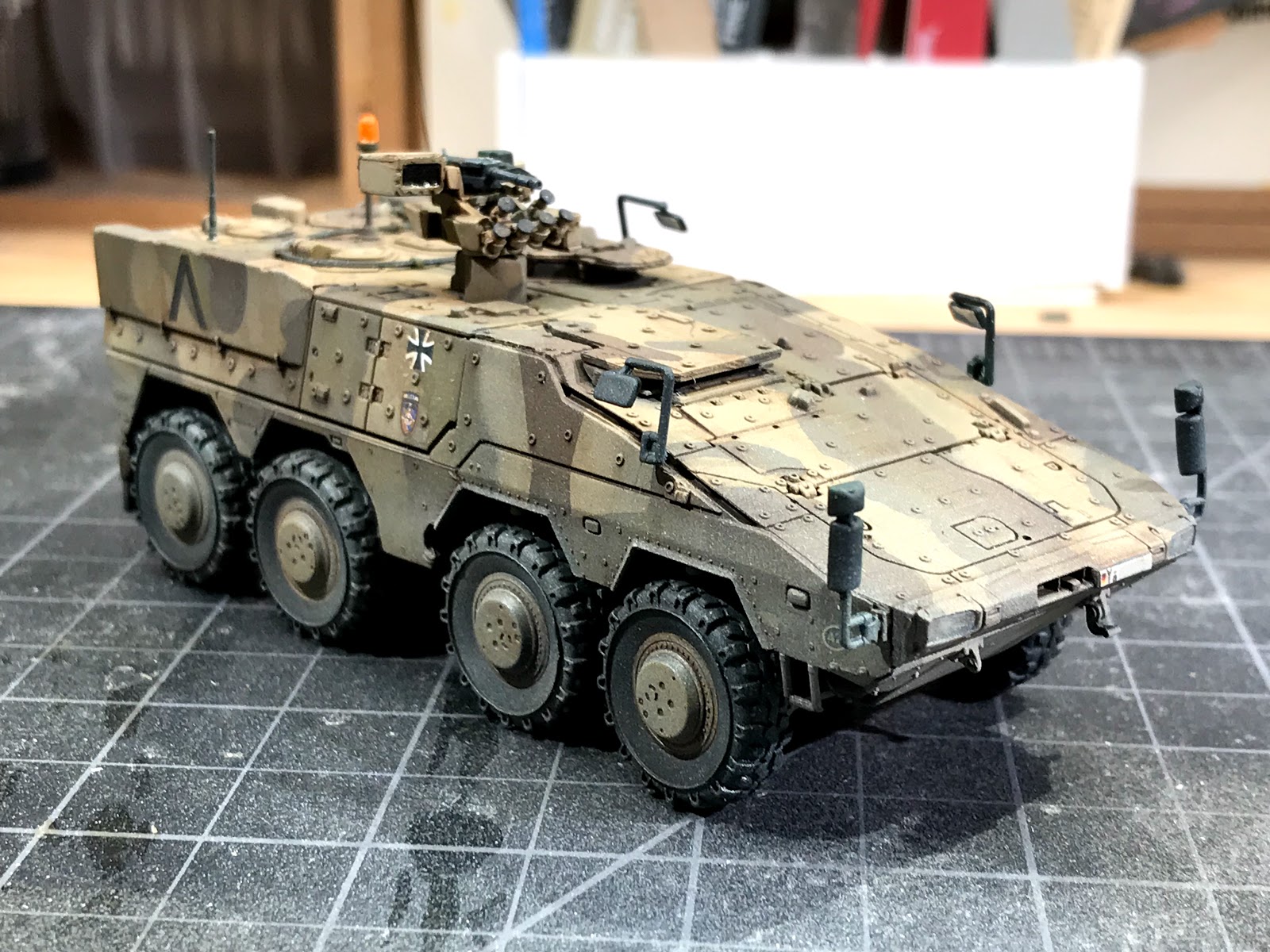
1/72 Revell GTK Boxer APC, Federal German Army

O, Canada! 1/35 Trumpeter Grizzly APC

The best tank ever fielded, but I'm prejudiced:
Tamiya 1/48 M1A2. An excellent, fun kit

S-Model 1/72 Sheridan Tank, the most fun of all to build and finish.


Friday, July 7, 2017

An Update on Electric Coal Haulers Out West from Bob Kaplan

Wire and pantographs under a big blue sky!
Photo used with kind permission of Robert S. Kaplan
One of my favorite railfanning and photography feeds is Bob Kaplan's Capitol Limited blog. Bob
travels the US and the world, and makes great photographs of the trains he sees. He's retired, so his travel tends--unlike mine--to have a lot more pleasure than business.

While I've never met Bob, I nonetheless look forward to his posts, to see where he's been and what kinds of trains he's seen lately.

I was delighted recently to see that Bob had been out railfanning electric coal haulers out in the desert of the Four Corners region of Arizona, Colorado, and New Mexico.
Go check out the great photos of the Black Mesa & Lake Powell that Bob brought back. BM&LP still hasn't repainted the for Nacional de Mexico E60s that I snapped back in 2005, but electrics under the big desert sky are still thrilling!

On a sadder note, Bob reported that one of the other electric coal haulers in the region, Navajo Mine, is momentarily closed and will not be operating its E60s much longer. Navajo has already been on the way to dieselization with the addition Alco C425s as helpers (if diesels absolutely must help electrics, OK, I can live with a late model Alco) but is set to take delivery of new General Electric EVO diesels. I'm sure there's some compelling cost modeling in there that makes new, super efficient diesels a better business case, but still--sad to see an electric operation go dark.

Check out the rest of Bob's blog--he gets to see a lot of trains, which he generously shares.

Friday, June 2, 2017

ACS-64 Heritage Units, Some of My Favorite Photoshoppery

Go look at it here, and Facebook users can find the source post on the Facebook 'Rail Enthusiasts' group. Commenters have worked up some other variations.  The Pennsy ACS-64 looks awesome, would like to see one in New Haven McGinnis colors.