 High-fidelity N scale electric modeling made a rather auspicious appearance in the August 2019 edition of Railroad Model Craftsman. The monthly RMC/Dremel Kitbashing Award went to Bryan Busséy's excellent New Haven EP-3 model. The model is exemplary: it is a zero-compromise representation of this steam-era electric box cab, notably reproducing the gnarly, steampunk-ish running gear and end porches. Bryan also posted this video of his EP-3 in motion:
Monday, August 26, 2019
N Scale Electric Scratchbashing in Railroad Model Craftsman
High-fidelity N scale electric modeling made a rather auspicious appearance in the August 2019 edition of Railroad Model Craftsman. The monthly RMC/Dremel Kitbashing Award went to Bryan Busséy's excellent New Haven EP-3 model. The model is exemplary: it is a zero-compromise representation of this steam-era electric box cab, notably reproducing the gnarly, steampunk-ish running gear and end porches. Bryan also posted this video of his EP-3 in motion:

Monday, August 19, 2019
Old Line Corridor Progress and New Photo Lighting
 |
| With trackwork and catenary in a relative state of completion, it was finally time to add trees and vegetation to the corner southwest corner hill of the Old Line Corridor in the upper lefthand corner of this photo. The 'canyon of trees' effect is similar to the Stemmer's Run or Odenton areas of the Northeast Corridor in Maryland. I used a new photo lighting set and backdrop for this photo; this photo was a kind of test shot taken with my smart phone. Will try some similar photos with my 'serious' cameras in the near future. |
 |
| Over in the northwest corner of the OLC, structures and associated parking areas are finally installed. Not particularly loving the big factory building; may be replacing it with something better but not sure what that might be. Final scenery details--shrubbage, weeds, road signs, etc.--are next up. Will need to whip up a few dozen new Super Trees to fill in these edges and marginal areas. Note also the backdrop and lighting. |
 |
| Another view of the new structures and parking areas. Lots of opportunities for weeds, shrubs, and other scenery details, as well as man-made detailing to add life and character. |
 |
| Especially enjoyed building and finishing the tractor supply in the rear and the grungy fence in the foreground. That hillside behind the buildings will be covered with vegetation and shrubbage. |
Thursday, August 8, 2019


Wednesday, July 3, 2019
Netherlands: the whole country is a hot spot!
 |
| That most iconic of Dutch trains, a Koploper, slowing for the station in the mid-sized city of Amersfoort, Netherlands. Rachel and I visited the Netherlands in early June for a rail safety conference. Steps away from our hotel in Amersfoort, 15 or 20 minutes of trackside loitering yielded eight or so trains in glorious late afternoon light. We rode a train very similar to this directly from Schiphol Airport in Amsterdam to Amersfoort. |
 |
| A Bombardier TRAXX locomotive in the colors of Nederlandse Spoorwegen (NS, the national railway of the Netherlands) pushing a passenger train out of Rotterdam station. I liked the NS TRAXX so much, I bought Arnold's N scale digital version as souvenir, along with a suitcase full of Gouda cheese. |
 |
| A tram in Rotterdam, just outside the train station. Rotterdam boasts beautiful green spaces, modern architecture, and like the rest of the Netherlands, bicycle paths and lanes everywhere. Tram right-of-way in Rotterdam looks like lawns with rails and overhead wire. |
 |
| A westbound Koploper enters the Amersfoort station. Nary a hassle or second look from security personnel or passengers while photographing Dutch trains. |
 |
| In the Amsterdam Centraal station, a Thalys high speed train bound for points south in Belgium and France. By the way, I didn't go out of my way for any of these photos--Rachel and saw trains, trains, and more trains just minding our business as tourists. |
 |
| Across the station, a Germany-bound ICE train, jointly operated by the DB (Deutsche Bahn, German railways) and NS. Both the Thalys and ICE arrive on special tracks equipped with high-voltage AC catenary. The NS system runs on 1500 VDC--like the South Shore!--and as a result, it's unusual to see electric locomotives from other AC-equipped European railways on Dutch rails. |
 |
| A Valleylijn Stadler car departing Amersfoort. Valleylijn is a private railroad operating branchline passenger service in central Netherlands--a kind of latter day interurban. Had we a few more days in the Netherlands, we would have ridden the Valleylijn to Arnhem and Nijmegen to see the sites of the WWII Operation Market Garden, the allies's ill-fated push across the Rhine in September 1944, immortalized in Cornelius Ryan's book A Bridge Too Far and David Attenborough's epic film of the same name. |
 |
| A Belgian TRAXX drags a grungy freight through Amersfoort. Note the four pantographs; this a dual-mode AC/DC locomotive. One of maybe three freights I saw during a week or so of intensive train riding and observation. |
 |
| The purpose of the trip was an international rail safety conference, and NS staged a tour of notable grade crossings around the Amersfoort area. This particular grade crossing is a rat's nest of safety challenges: it cut through an active station, is adjacent to a school and an al fresco restaurant, and the roadway has motor vehicle, bicycle, and pedestrian lanes. NS is using some sophisticated sensoring and AI-enabled video to appropriately monitor and signal this crossing. But that wasn't what interested me most--I was intrigued by those cement arch catenary towers, which appeared to be unique to this line. Our NS host explained that this line was built in the middle of WWII when steel was in short supply, so these concrete arch bridges were used. They are currently considered 'heritage' architecture, which means that when one of them was damaged in a recent traffic incident, NS had to replace it with a custom made structure using WWII era techniques and materials. |
 |
| The older iconic NS electric MU, the Hondekop, or 'Dog Face', on the museum track at Amersfoort. The banner on the side is leftover from a fan trip sponsored by Pijp-Lines, a major Dutch hobby shop. I bought Piko's N scale edition as a souvenir. |
 |
| The Hondekop is such an icon of Netherlands' beloved railroads, that this cartoon 'Dogface' is a stand-in for NS workers. This statue adorns the entrance of the NS training facility in Amersfoort, where Rachel' rail safety conference was held. |
Monday, May 20, 2019
Trains I See, Delmarva Edition
 |
| We're spending more time out on the Delaware shore, and our drive out is crisscrossed by a number of short lines. Here are two Delmarva Central MP15ACs idling under an elevator at Seaford, Delware. |
 |
| Judging by the number boards and offset headlights, these are ex-SP units. The air conditioning units on the cab rooves add more gnarly visual interest to these handsomely liveried MP15ACs. |

Monday, May 13, 2019
Things You Don't Realize About N Scale: Vehicular Slim Pickins
 |
What does every vehicle in this photo
have in common? German prototypes,
including the Siemens ACS-64. That
might work for the contemporary North-
east Corridor Region, but probably not
for Appalachia or the rural midwest. |
Vehicle modeling is an important hobby-within-a-hobby in model railroading, and I'm learning fast that vehicles might be among the final frontiers of successful N scale modeling.
Last summer, while wandering around Chicagoland, I visited Desplaines Hobbies, which has a large selection of S scale and also die cast vehicles in 1/64 scale. It occurred to me that the selection S scale vehicles must be one of the attractions of that comparatively rare scale. My favorite S scaler, Trevor Marshall, confirmed to me that vehicle modeling is part of the fun of that scale, and that vehicles provide an excellent visual queue for setting the era and mood of a layout.
 |
That's better--a railroad police Ford SUV--that most American
of vehicles--prowling the right-of-way for trespassers. |
A few months later I visited John Sethian's O scale Pennsy layout. I raved about his catenary and fleet of O scale electrics on this blog, but another feature of his layout that impressed was the vast population of era-specific trucks and automobiles.
The importance of vehicles to a visually engaging layout isn't really new news to me--I have already put more than a few hours into finishing HO vehicles for my Dunes Junction layout, and I'll also point out that era- and region-specific vehicles in realistic poses were one of the impressive elements of Tim Nicholson's modeling, which I covered in a recent post.
* * *
With the Old Line Corridor nearly fully scenicked, I've arrived at the detailing stage. I've been thinking about signage, wayside details, weeds, and yes, vehicles. A recent visit to a New York area hobby shop with what counts as a deep stock of N scale vehicles yielded just under a dozen or so vehicles, which I immediately placed around the Old Line Corridor.
 |
The long distance bus is a UK model with the steering on the
wrong side, but it represents one of the ways I casually railfan
the New Jersey portion of the Northeast Corridor, which
is through the windowz of one of the cheap buses Rachel and I
often ride into New York and Connecticut. Also, that white
Rover Defender is something that would likely only ever be seen in the Tri-State area, or maybe somewhere in Northern California. |
 |
Atlas markets some of the only 60s/70s era
vehicles, seen here in the lower part of the
photo, while that 70s/80s Herpa VW Golf
in the upper part of the photo hasn't been on
the market for some 15 or 20 years
|
Monday, May 6, 2019
Thinkin' Things About Big Ol' Narrow Gauge Diesels
 |
| I always wondered if an Atlas C-628 could be used as the basis for an HOn30 DL535E . . . looks short overall, and the trucks are very short in comparison to those lanky Alco C narrow gauge trucks. But still . . . |
Monday, April 29, 2019
Finished Island Model Works Silverliners Spotted in the Wild
 |
I nearly spit out my decaf when this stunning photo graced the top of a recent Model Railroad Hobbyist blast email. The models and photos are the work of Tim Nicholson. The modeling alone caught my eye: the colors and textures alone capture the look and feel of the Northeast Corridor in late spring or summer. Then I realized I was looking at an electric MU car under wire! Woo hoo! Photo and models courtesy of Tim Nicholson and Model Railroad Hobbyist.
|
 |
There's a lot of great modeling going on in Tim's deceptively simple vignettes. In addition to doing a bang-up job with a tough Island Model Works kit--the lights and the little details like wipers, marker lights, hoses, safety chains, of which modern passenger equipment seem to be full--the right-of-way and structures show remarkable craftsmanship. Details to look out for in this photo: concrete detail, station windows, and joint bars. Photo and models courtesy of Tim Nicholson and Model Railroad Hobbyist.
|
 |
| And those poles and that wire. Notice the fine gauge wire, and the compound catenary (the prototypically correct double contact wire). The cantilever poles and insulators are also prototypically proportioned. Hoping to see more of Tim's work! |
Wednesday, April 10, 2019
Modern Narrow Gauge, Another Persistently Obtuse Interest
 |
| Modern narrow gauge I have known: PeruRail GE diesels in Aguas Caliente, station stop for Macchu Picchu. |
Nonetheless, the modeling itself intrigued me, and I especially gobbled up anything on Bob Hayden and Dave Frary’s Carrabasset and Dead River Ry. layout. The C&DR looked interesting while also looking workaday--it was a slice of life in rural New England in days gone by--instead of spectacular Rocky Mountain and Wile E. Coyote vs. Road Runner southwest vistas.
During this same time period, in the March 1979 Model Railroader, a "Trade Topics" review of a brass PSC HOn3 White Pass & Yukon DL535E appeared. Here was a weirdly proportioned, butch-looking Alco, vaguely reminiscent of an Alco C420, and I was intrigued. WP&Y information was hard to come by for this middle-school-aged Hoosier, but over the years I came to know more about this modern narrow gauge line and its second-generation diesel fleet.
 |
| A White Pass & Yukon DL535E narrow gauge road switcher. It’s about the size of an RS3, but is proportioned more like a C420. Note the ‘swole’ radiator and filter protuberances--some- thing that the Alco/MLW engineers couldn’t figure out how to shrink down to 3’ gauge proportions. Photo courtesy Wikipedia /Yufei Yuan |
Even more interesting is discovering that there are even examples of narrow gauge heavy electrics, and one doesn't need to look far to find HOn30 (called HOe in Europe), HOm (HO meter gauge) or even, after a fashion, N scale narrow gauge electric railroad models. (Kato offers 1/150 scale models of modern Swiss meter-gauge Rhaetian Railway models that run on conventional 9 mm N gauge track.) Practically every issue of Continental Modeller covers at least one European or other international narrow gauge layout, and most are 'modern' if not post WW2.
But I've often thought about splitting the difference: how about a modern, updated C&DR? Turns out I'm not the only one with this idea. Ted Alexander's Norfolk Terminal (NT) layout, featured here on Nick Pautler's To Points East blog, is indeed an updated, modern C&DR. Ted has done an excellent job capturing the look and feel of what a modern Maine two-footer might actually look like. And unlike many model narrow gauge pikes, it has a sparse, industrial look and feel instead of a cute and whimsical fantasy junkyard vibe. Nothing against cute and whimsical fantasy junkyards--I certainly enjoy looking at them, especially those that seem to spring up among On30 model railroaders--but they just aren’t my jam.
Thoughts of a modern passenger and rock hauler, in an interesting, not-often-modeled setting have come back to me repeatedly over the years. That setting might be the Alps, a Caribbean island, a Latin American country, or even rural New England or eastern maritime Canada. Doing so in O, S, or HO would give me the chance to indulge a subsidiary interest in vehicle modeling that my recent N scale modeling doesn’t avail well. And of course, there’s the possibility of wires and pantographs over the weird little trains. Let’s see what turns up . . .
Monday, April 1, 2019
DCC, Complaining About
Bernie Kempinski admitted in a recent post on his USMRR Aquia Line blog that he loves to complain about DCC, and this wasn't his first run at this most evergreen source of model railroading disappointment. He unleashed a torrent of bile on DCC quirks and incompatibility back in 2017 or so, which I somehow missed.
Regular readers here know that I certainly have my own DCC grievances, but I usually frame my DCC dyspepsia by expressing envy for the European approach to DCC. (Like, why don't we North American model railroaders have graphic interfaces on our controllers, seamless compatibility with our consumer gadgets like smart phones and tablets, and for the love of all that is good, standard decoder plugs?)
Bernie lamented in 2017 that the rat's nest of incompatible programming specs and protocols that cause various combinations of models, decoders, programmers, and controllers to not work well with each other. He also noted that a number of DCC products intended to work with computers are actually only narrowly compatible with a few types of computers and operating systems.
I've certainly experienced those very problems in my own adventures with DCC, which I finally resolved by acquiring a dedicated Windows 10 computer and then my ESU ECoS controller, which has sufficent amperage and support for multiple DCC and proprietary control protocols.
In other words, I solved my DCC problems by acquiring some major DCC artillery worth around a cool grand, although I got lucky acquiring the ECoS and the Windows 10 computer second-hand for half that.
Solving ordinary DCC challenges shouldn't bust the hobby budget.
Another DCC observation: I've noticed that decoders are often defective right out of the package. Interestingly, the first DCC control system I ever bought, a Digitrax Zephyr, was also defective right out of the box. Are there perhaps low expectations for manufacturing quality in this space?
Fortunately, all of the DCC manufacturers I've dealt with have robust warranty policies. I haven't kept detailed track of my experiences with defective decoders, and I will freely accept that my own mishandling or misinstallation might have played a role, but I think around 10% of my 40 or so decoders--across several DCC brands--have had some kind of failure at or very shortly after installation. This failure rate did pick up with launch into N scale--maybe tiny decoders are more fragile and/or defect prone?
But I've had enough installation jobs stalled by the 2-4 week warranty return process to have noticed and make this complaint.
So that's where I will pile on to Bernie's specific complaint about sound--that (modern) locomotive sound is indeed so much noise, to which I will add that sound might just be a bridge too far for many smaller models. As a result, nearly all N scale and many HO models end up being expensive, unreliable little industrial noise makers.
One additional data point for this assessment is an experience I had at the 2018 O Scale convention here in Rockville, MD, last year. I was chatting with Tony Koester, and a sound-equipped O scale SW1500 that was running on a nearby modular layout was loud and high quality enough to interrupt our conversation! At this point, I realized that speaker size and installation make a critical difference to the model railroad sound experience.
I'm certainly not opposed to model railroad sound--I just think that tiny locomotive-based speakers might not be the optimal approach. On small layouts, stationary speakers--even cheap ones, like, say, computer speakers--would undoubtedly render sound more dynamically and faithfully than sugar-cube sized speakers encased in moving locomotive shells. They would also allow for other environmental sounds to be mixed in, such as right-of-way sounds (singing wire, something I've touched on previously), nature sounds (cicadas, for example, would be appropriate for the Old Line Corridor's wooded mid-Atlantic locale), and of course, Bernie's dreaded industrial noises.
The moral of the sound part of this story: maybe model rail manufacturers are expecting DCC to do too much, and maybe there are better ways to add the sonic dimension to our model railroads.
Regular readers here know that I certainly have my own DCC grievances, but I usually frame my DCC dyspepsia by expressing envy for the European approach to DCC. (Like, why don't we North American model railroaders have graphic interfaces on our controllers, seamless compatibility with our consumer gadgets like smart phones and tablets, and for the love of all that is good, standard decoder plugs?)
Bernie lamented in 2017 that the rat's nest of incompatible programming specs and protocols that cause various combinations of models, decoders, programmers, and controllers to not work well with each other. He also noted that a number of DCC products intended to work with computers are actually only narrowly compatible with a few types of computers and operating systems.
I've certainly experienced those very problems in my own adventures with DCC, which I finally resolved by acquiring a dedicated Windows 10 computer and then my ESU ECoS controller, which has sufficent amperage and support for multiple DCC and proprietary control protocols.
In other words, I solved my DCC problems by acquiring some major DCC artillery worth around a cool grand, although I got lucky acquiring the ECoS and the Windows 10 computer second-hand for half that.
Solving ordinary DCC challenges shouldn't bust the hobby budget.
* * *
Another DCC observation: I've noticed that decoders are often defective right out of the package. Interestingly, the first DCC control system I ever bought, a Digitrax Zephyr, was also defective right out of the box. Are there perhaps low expectations for manufacturing quality in this space?
Fortunately, all of the DCC manufacturers I've dealt with have robust warranty policies. I haven't kept detailed track of my experiences with defective decoders, and I will freely accept that my own mishandling or misinstallation might have played a role, but I think around 10% of my 40 or so decoders--across several DCC brands--have had some kind of failure at or very shortly after installation. This failure rate did pick up with launch into N scale--maybe tiny decoders are more fragile and/or defect prone?
But I've had enough installation jobs stalled by the 2-4 week warranty return process to have noticed and make this complaint.
* * *
Bernie's recent post reiterated his 2017 complaint that diesel sound, which he dismisses as "industrial noise," is the culprit behind possibly needless DCC complexity.
I agree with Bernie about industrial noise. Modern diesels and electrics do have a kind of sonic sameness, with some differences here and there. That sameness is exacerbated by the small speakers common to small HO and nearly all N scale locomotive models.
So that's where I will pile on to Bernie's specific complaint about sound--that (modern) locomotive sound is indeed so much noise, to which I will add that sound might just be a bridge too far for many smaller models. As a result, nearly all N scale and many HO models end up being expensive, unreliable little industrial noise makers.
One additional data point for this assessment is an experience I had at the 2018 O Scale convention here in Rockville, MD, last year. I was chatting with Tony Koester, and a sound-equipped O scale SW1500 that was running on a nearby modular layout was loud and high quality enough to interrupt our conversation! At this point, I realized that speaker size and installation make a critical difference to the model railroad sound experience.
I'm certainly not opposed to model railroad sound--I just think that tiny locomotive-based speakers might not be the optimal approach. On small layouts, stationary speakers--even cheap ones, like, say, computer speakers--would undoubtedly render sound more dynamically and faithfully than sugar-cube sized speakers encased in moving locomotive shells. They would also allow for other environmental sounds to be mixed in, such as right-of-way sounds (singing wire, something I've touched on previously), nature sounds (cicadas, for example, would be appropriate for the Old Line Corridor's wooded mid-Atlantic locale), and of course, Bernie's dreaded industrial noises.
The moral of the sound part of this story: maybe model rail manufacturers are expecting DCC to do too much, and maybe there are better ways to add the sonic dimension to our model railroads.
Monday, March 18, 2019
OMG, the layout is almost finished
 |
| With the near completion of the N Scale Architect curtain wall factory (an upcoming post will give a detailed review and lessons learned), the Walthers tractor dealership, and the Pikestuff warehouse, the Old Line Corridor is getting closer to completion. Already thinking of how additional trees and vegetation, right of way details, signage, and vehicles will give the layout a completed look. |
 |
| A "drone" shot of the suburban Maryland-inspired industrial area with principal structures roughly positioned in. Next steps are to blend into the surrounding scenery and add some additional atmospheric details. |
 |
| The purpose of that large-ish N Scale Architect factory is to block the view of the staging yard from the front of the layout, as seen in the background here. A fence and additional vegetation will enhance the blocking effect. |
Saturday, March 16, 2019
Catching the White Whale: Amtrak ICE Trainset
It does have a few quirks. As noted by the encyclopedically tireless tester of all N scale locomotives, Spookshow, it has some tricky close couplings, which turn out to be simple drawbars with NEM coupler plugs and sockets.
Its early 90s production also predates 'DCC ready', so DCC installation will be either old school with lots of soldering and whatnot, or expensive, as Fleischmann's recommended DCC conversion is to remove the Amtrak ICE shells and install them on the drives for a separately offered equipped ICE loco set. That DCC-equipped ICE loco set, is, of course, even rarer than this ICE Amtrak set and usually fetches an even higher premium price. Nonetheless, glad to have this prize running on the Old Line Corridor.
Tuesday, March 5, 2019
How many HO locos to pull an actual loco?
Monday, February 25, 2019
Model Railroader Magazine Project Layouts Can Be Bought, Apparently
A Kalmbach Publishing acquaintance mentioned to me a few months ago that Model Railroader project layouts were taking up valuable space around the Kalmbach offices, and as a result, MR editor Hal Miller was keen to sell them off. The Virginian, Salt Lake, and Red Oak layouts, among others, could be had for bargain prices. Transportation would, of course, be the buyer's responsibility.
I wasn't sure if I was having my leg pulled, or if this was some Model Railroad Industrial Complex gossip that would not be appropriate to share, so I more or less forgot about the conversation. Then I heard this interview with MR Video editor David Popp, and heard it from him:
Monday, February 18, 2019
Random Developments and Thoughts
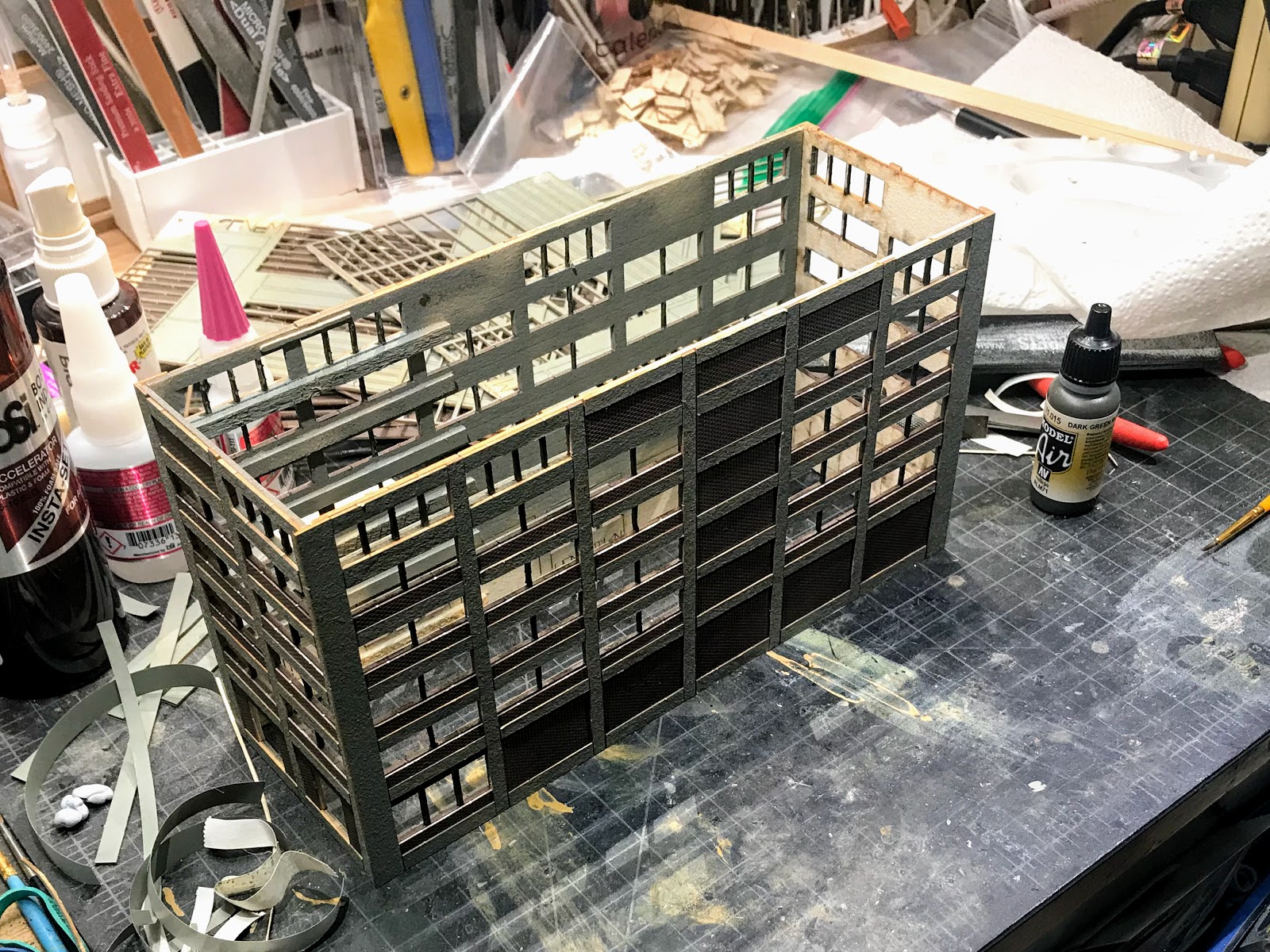 |
| First, that moment when 200 or so seemingly random and abstract parts transmogrify into something recognizable as a model. In this instance, the transformation was particularly rewarding because of the medium of this N Scale Architect kit--the parts are all cardstock strips and rectangles that were difficult to envision as a factory. |
 |
| Second, it's time for another pontification about how the Europeans do DCC. I've done a couple of DCC installs on European prototype N scale models in the past couple of months, which used the Next18, AKA NEM 662, decoder socket. The decoder socket and plug --see above, 'Buchsenleiste' is one the locomotive, 'Stiftleiste' is on the decoder--is only a quarter of an inch or so across, making for a tiny little decoder. Which leads me to wonder why Atlas, Walthers, and Kato DCC installs still involve special replacement printed circuit boards instead of Next18 or another standard socket, like the NEM 651. Intermountain, for its part, does use an NEM 651 socket in its ES44 models. Seems like an opportunity for efficiency and reduced production costs that would benefit modelers and the model railroad marketplace. |
Subscribe to:
Posts (Atom)