Thursday, April 18, 2013

Experimenting With Weed(s)

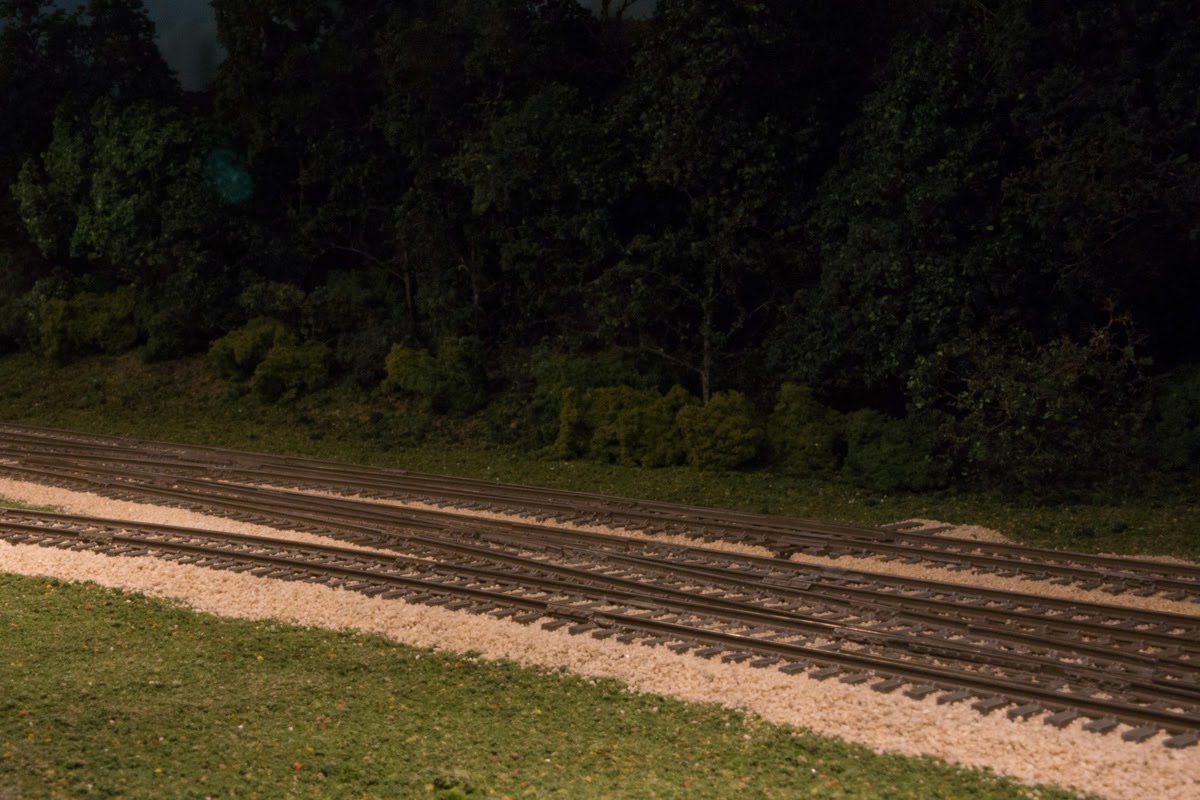
It's been a while since I've posted any Dunes Junction progress, but here's some scenery experimentation that's been going on. I've been trying some combinations of Heki grass mats and Silfor weed tufts. So far so good: lots of straight up white glue (Elmers and Aleen's Tacky) and t-pins to hold things down while the glue dries seem to be the keys to success.


Monday, December 10, 2012

Flag Stop Parking Lot

The Mineral Springs Road flag stop parking lot.  The lot is Highball Z scale light gray ballast held down by slightly thinned white glue. After it dried, I sanded the 'busy' parts of the lot with coarse sandpaper to simulate wear from vehicle traffic.  A wash of raw sienna acrylic, followed a day or so later by a dry brushing of titanium white, completes the look.

Another view of the lot. The grayish flat spots in the lower  right of the lot are where the flag stop shelter and the crossing signal will go.

Sunday, November 18, 2012

Track Ballasting and Weathering Complete + Lessons Learned


Close-up of weathered and ballasted track. The final stage of track weathering described in the Frary and Hayden scenery book is a light drybrushing with Titanium White oil paint, a step that really blends things together and also shows off the incredible detail of the Peco track and turnouts.
Track ballasting and weathering at Dunes Junction are complete! Per my earlier posts, I'm using a combination of techniques from Model Railroader magazine (link here for a reprint of Cody Grivno's track ballasting article; requires registration) and the incomparable How to Build Realistic Model Railroad Scenery (3rd Edition) by Dave Frary and Bob Hayden, which ought to win some kind of publishing industry award for most timelessly useful and densely packed how-to book of all time.

A couple of key lessons learned:
  • Disposable 1" or 1 1/2" foam paint brushes are awesome for spreading, leveling, and shaping ballast.
  • Woodland Scenics Scenic Cement is essentially a ready made version of the matte medium recipe that Frary and Hayden describe in their book. If I were building a large layout, I would probably make my own per Frary and Hayden to save a few bucks--Scenic Cement is around $8 or $9 bucks per 16 oz. bottle.
  • Cody at Model Railroader uses an airbrush to weather his ballasted track, but Frary and Hayden explain how to accomplish the same results with washes and drybrushing, a method that takes longer but offers more control (and doesn't require an airbrush).
Finishing the overpass and the flagstop are up next.
Overview from southwest.

Overview from southeast.


Monday, November 5, 2012

Why so serious (about your model railroading)?

Over at Trevor Marshall's Port Rowan in S scale blog (that's Trevor Marshall of the incomparable The Model Railway Show podcast), the talk is about runnin' trains--you read that right, just plain ol' running of trains, just to see them go.

In a recent post, Trevor recounts the experience of a friend who visited a famous model railroader's large home layout:
My friend took along some beer as a thank you for imposing on the [Famous Model Railroader’s] time and after a tour of the layout room tour in which he ooohed and aaahed appropriately, my friend asked, “So, FMR, why don’t we run a train or two?” 
The answer was, “No, I don’t think there are any trains scheduled to run on the railroad today.” 
As you can imagine, my friend was ready to take back his beer – perhaps to help wash out the sour taste the experience left in his mouth. Now imagine how this attitude would go over with someone who is not already in the hobby. After an experience like that, chances are they never will be.
Trevor goes on to discuss informal train operations that are probably similar to what we'll eventually see at Dunes Junction, but I realized once again that one of my key model railroading goals is to create community--not to turn people away or cause people to not want to share beer (heaven forbid!).

I can't imagine getting really excited about model railroading that pushes people away or excludes new or non-modelers. Thus my decided indifference to this 'serious' model railroading that has seems to have little regard for newcomers or outsiders.

When visitors to our home look at the a-building Dunes Junction, I can explain the concept in one simple sentence: these are my favorite trains and places from my youth back in Indiana. All but the littlest visitors grasp this immediately, and understand why I go to all the effort of fancy trees, exactly colored track ballast, DCC, rare models from eBay, and other geekery. I have a stepstool for the little ones that just like the trains and lights and horns, and they 'get' it for other equally valid reasons.

Another model railroad blog, Some Railroad You've Never Heard Of, also touched on model railroading's 'serious' problem recently.  What caught my eye first in a post titled 'Model Railroad: From Family Room to Basement' was a happy picture of the blogger, his wife, and their newborn baby. Some Railroad's author, Titus, is focused on narrow gauge and advocates a Do-It-Yourself approach to our hobby. But Titus reflects a bit on the connection between his slim gauge modeling and that wife and little baby.  "What," he asks, "will my friends and family like the most or be the most engaged in regarding my layout?"
What if we start making decisions on our layouts, influenced by prototypes, but based on what would draw in our friends and family more? Would that actually free us to make the compromises we know we need to make, without second guessing them the entire way through? Would that allows us the freedom to enjoy our layout with others because we aren't consumed with an unholy pursuit of perfection? Might we just find that others can enjoy our layout just as much as we can, which gives our railroads a purpose outside of moving passengers and freight around a mini world?
Here's hoping that Titus's little narrow gauge railroad plants a little seed of interest, of curiosity, of imagination in the mind of his wife's and his new child. She doesn't need to become a model railroader for that layout to be a success.  Patient grownups and their sometimes fanciful model railroads opened for me and many others a whole world of non-railroading interests and possibilities.

Little kids, neighbors, and party guests are part of Dunes Junction's audience. They're not the only reason I'm building Dunes Junction, but they get to be part of the audience. And hopefully they all walk away with something more than what they came in with.

Friday, November 2, 2012

Quick Snaps of Ballast Progress

A couple of enforced days off because of Hurricane Sandy--and miraculously, no power outages--gave me an opportunity to catch up with Dunes Junction. More ballasting . . .
My ballast dispensing apparatus, ready for action


Ballast taming accoutrements taking a rest

Monday, October 29, 2012

Train Pictures From the Blogging Hiatus

Lots of busy-ness in my non-model railroading life--packing our youngest off to college, big changes at work, family visiting--has caused a several month hiatus at Up Dunes Junction.  But this post marks the end to that hiatus, and I thought I'd include some photos of trains I've bumped into on my travels over the past few months.

Buffalo & Pittsburgh tunnel motor gets ready to depart Salamanca, NY, 
above and below


Dig that NYC lightning-stripe paint job on this Finger Lakes U-boat outside of Syracuse, New York


Norfolk Southern intermodal freight in the rain at Gallitzin, Pennsylvania
NS helpers on the move at Horseshoe Curve, Altoona, Pennsylvania
NS unit train gliding downgrade on dynamic brakes at Horseshoe Curve.
A view across the curve at an eastbound NS unit train.
Horseshoe Curve long shot in the rain: that 's what Allegheny mountain railroading looks like.

Monday, July 9, 2012

Track Ballast + 'Good Enough' Camera Tricks


Testing my aged-to-perfection matte medium and Highball Natural Lime-
stone ballast on small pieces of (expendable) transition track.

With power outages, college searches, graduation, big work projects, and all those other real-life distractions in the rear-view mirror, we're finally working on Dunes Junction again.

Track ballasting has begun. I started small because I have a massive gallon jar of matte medium thinned and prepped per the instructions in the Frary and Hayden scenery book, which is also something like six or seven years old.


I am using Highball #220 HO Natural Limestone ballast, which appears (to my eye, anyway) as good match for South Shore's ballast color and texture. Limestone, by the way, is in some abundance around Northwest Indiana because it is an ingredient in the manufacture of the region's leading production commodities, concrete and steel.
Like Jack Nicholson's Joker once said, 'It's hard to stay inside the lines'-- Here I am already putting ballast down on the layout. Hope my vintage matte medium works out!


I'm also using the Model Railroader magazine technique of ballasting between the rails first that I've previously mentioned. This technique goes somewhat more slowly than trying to get shoulders and between-the-rails at the same time--but it is much neater and gives much more control.

Meanwhile, I'm exploring the Anti-Motion Blur mode on my new Sony NEX-7 camera, which allowed me to take the two accompanying photos without busting out the tripod and remote control. In this mode, the camera apparently takes many exposures in rapid succession and then automagically processes them into a usable image. Not altogether happy about the depth of field, but it works. The photographic result is 'good enough', as Allen McClelland would have put it, at least good enough for this little old blog.

Stay tuned for more ballast progress . . .

Thursday, July 5, 2012

In Other News, I See Non-Electric Trains Sometimes

The past couple of weeks have been quite eventful, with epic power outages here in Washington and all kinds of other work and neighborhood craziness.  But I did manage to get these snaps over at nearby Point of Rocks, Maryland, a couple of weekends ago . . .
CSX freight at Point of Rocks, Maryland

Amtrak at Point of Rocks, Maryland


Friday, June 22, 2012

Trains I Ride On Everyday, Part 748

Work has been getting in the way of progress on the Dunes Junction, so it's only fitting that I post a photo of new a-building Washington Metro cars under construction, courtesy MetroForward's Flickr stream and the the Yahoo commutermodeler group.  Metro whisks me back and forth to work every day, which ensures that I do get a small hit off the electric railroad crack pipe on a daily basis.
Our new Metro 7000 series car under construction.  That knobly black end is quite butch and industrial looking compared to our current inset brown ends, which are standard across all series cars currently in service. Photo courtesy of/All rights reserved by MetroForward

Monday, June 11, 2012

O Scale South Shore Model Sighting!

In a sort of sad post announcing the retirement of O scale custom traction model maker Jean Deschenes, Ed Halstead at the Modeling Insull's Empire in O Scale blog posted awesome pictures of O scale South Shore equipment built by Jean.
This is awesome stuff. . . very inspiring! Makes me want to go out and build South Shore models!
Ed Halstead photo, courtesy Modeling Insull's Empire in O Scale http://modelinginsullsempire.blogspot.com/
Jean's retirement ain't exactly premature or undeserved--he's been at it since 1965! Says he wants more time for his ship modeling.  And the models look great . . . go check out the post and see for yourself.

Friday, May 25, 2012

Again with the Mountain Railroading? How about a flatland railroading book?

This little ditty was in my email a few days ago . . .
If model railroading publishing giant Kalmbach really wanted to impress us, they'd get Tony Koester
to do a flatland railroading book instead of mountains, again.

I got an email a few days ago announcing Kalmbach's newest Tony Koester title, Model Railroader’s Guide to Mountain Railroading, and I thought, "oh swell, more tunnels, more coal mines, more puff-ball trees, more rock castings, more basements full of Rockies and Appalachia . . ."

Don't get me wrong--I am actually a Kalmbach superfan, with a long history of subscriptions to and even a couple of by-lines in Kalmbach magazines, plus a sizeable library of Kalmbach books.

But I do think those nice people at Kalmbach love them some mountain-y railroads. I came up as a little guy reading Model Railroader and Trains--and for a long time, I thought the trains in my home area of Northwest Indiana were somehow deficient because we had no tunnels or mountain vistas or high trestles or any of that stuff that seems to get a lot editorial love up in Waukesha.

In addition to this new book, Model Railroader just concluded a Virginian HO project layout, and the year before, a high desert N Utah layout--both were outstanding examples of what could be done in small spaces with decidedly non-exotic materials and techniques (that N layout ran on Kato Unitrack, for crying out loud).

But it's always mountains, mountains, mountains.

Sure, I know that tunnels and bare rock faces and trestles are all 'model-genic' but I would really like to see Kalmbach and its experts like Tony Koester turn their creative guns on the great flat spaces that are actually what a lot of American railroading actually looks like.

So, hey Kalmbach, how about a project layout or a book featuring the glorious flatlands? It actually shouldn't be too hard: after all, Tony Koester does have a flatland layout in his basement, and so does Bill Darnaby, who has penned an article or two for Model Railroader and the Layout Planning annuals that Tony edits.

A project layout in one of the big model railroading magazines featuring midwest themes is certainly overdue. Maybe Tony and Bill could build a layout from one of those Layout Design Element 4x8 plans that have turned up in Model Railroader and its specials, with a town or scene on the front of the layout and staging area on the back, out of sight.

There would be lots of flatland-specific techniques to show off in such a project layout. For example, trees, weeds, crops, and other vegetation of the flatlands, or region-specific architecture, right-of-way, and engineering practices. The visual trickery of seeming featureless landscapes could also be covered--how to disguise passages through backdrops, or use of forced perspective.

I'd buy it if they printed it.  I'll probably buy the mountain book, anyway, though, too.

Wednesday, May 16, 2012

My Own Awful Truth: Temporary Markings for the Geep

Doesn't it look awesome? Now I have a reminder of its DCC address. It will also shame me into getting this project done.
I didn't come up with this myself--that wiseacre Joe Fugate guy at Model Railroad Hobbyist wrote in his May 2012 "Reverse Running: The Awful Truth" column about how he used yellow sticky notes to temporarily re-number some out-of-the-box diesels. I needed to do this so I could have a visual reminder of the number I programmed into its DCC decoder--it's the number that I will eventually apply.

While I gleaned a marvelous modeling tip from Joe's column, he was actually telling a story about how people who build layouts don't have time to finish fancy locomotive projects. But I'll take a good modeling tip wherever I can find one.

Saturday, May 12, 2012

Some More Thoughts on Photography

A lot of good insights here, a few of which directly apply to model and railroad photography:


100 Tips from a Professional Photographer [Photography]

Wednesday, May 9, 2012

Northwest Indiana Trains in the New York Times

Indiana Harbor Belt's Gibson Yard in Hammond, IN in National News.  The South Shore is a mile or two north of this
spot.  Purdue Calumet, my alma mater, is a few miles south. Memories! | Nathan Weber for The New York Times
Trains of northwest Indiana are in the news again, this time in a New York Times article on the project to improve rail connections and grade crossings around Chicago. The photo above appeared in all its glory at the top of the web version of the story. That is Indiana Harbor Belt's Gibson yard in Hammond, Indiana--my old stompin' grounds. Drove across that bridge hundreds of times on my way back and forth to classes at Purdue Calumet.  If I weren't a South Shore modeler, I'd think really hard about an IHB layout--lots of good small layout possibilities, not to mention a roster of small-radius friendly SWs and GPs.

Monday, May 7, 2012

Takeaways from Photography at Dunes Junction

Samsung TL500
Something I strive to do with each Up Dunes Junction post is include some decent photographs. Part of this photograph policy is the conventional wisdom of blogging--posts with pictures get more hits, supposedly, but it's not as if Up Dunes Junction is Gawker or Huffington Post or some other 'mainstream' blog that counts on millions of visitors. I'm not going for lots of hits--just trying to share and make friends with other model railroaders, heavy electric fans, and South Shore watchers.
So photographs help me tell the Dunes Junction story. And because we are talking railroading and model railroading, which is a very visual enterprise, photos, or at least illustrations and graphics, are an essential part of the storytelling.

I became interested in photography in my teens because of trains.  I started with a 110 Instamatic and graduated to Canon 35mm single lens reflex (SLR) cameras by the 80s. I've since joined the digital revolution--and it's difficult to overstate how digital has made photography cheaper, better, and easier than it ever has been ever to photograph trains, big and small.


Sony NEX-7 with 18-55mm lens
My own approach to photography for Up Dunes Junction demonstrates how inexpensive gear, plus some relatively easy techniques, can yield decent model railroad photos.  Most of the photos on the blog were taken with a so-called advanced point-and-shoot camera--a Samsung TL500--but more basic point-and-shoots can yield images of comparable quality.

A digital SLR or one of the new mirrorless interchangeable lens cameras offers more options and controls. I recently acquired a Sony NEX-7 interchangeable lens camera, which I have been using for my most recent Up Dunes Junction photos.  It offers a decent selection of lenses and very fine exposure and focus control, as well as an excellent wireless remote control.
The main trick is to use built-in close-up and self-timer features and a cheap tripod. Most point-and-shoots have a close-up feature marked with a flower icon--this will give good close focus.  Self-timer mode eliminates camera shake, as does the cheap tripod. If a remote or cable release is possible, it will also eliminate camera shake. 

Sony NEX-7 camera on tripod next to Dunes Junction
The other trick is practice and repetition.  When I first shot trains back in the late 70s, I carefully budgeted each shot because of costs--in those days, each image cost around 30 cents apiece.  Now multiple shots at different settings and lighting conditions cost virtually nothing--and you only need show the good images.  I estimate that for every photo that makes it on to the blog, I discard around ten or so.