Sunday, April 24, 2016
Thoughtful Blog Post on the Near Future of Model Railroading
Titus over at the Some Railroad You Never Heard Of blog has a thoughtful post about the future of model railroading (look for more 3D printing and CNC cutting--laser cutters, Cricuts, and the like--but some things like track as we currently know it are here to stay) and model railroading media (streaming video is the future, print fading away). Stop what you're doing and go read it. He's got me wondering if I should have a YouTube channel alongside or even in place of this blog . . .


Sunday, April 17, 2016
The Capitol Limited Blog Makes Neighborhood Trains Look So Dramatic
 |
| The Capitol Limited/Robert Kaplan |
I enjoy every one of his posts, and this one capturing CSX and MARC in Gaithersburg, MD during a recent snow storm (one of those events that paralyzed the National Capital region, BTW) particularly caught my attention. It's a fine example of a photographer using what's at hand to make railroading that might otherwise seem ordinary (to me, anyway, by dint of its familiarity).
Sunday, April 10, 2016

Sunday, April 3, 2016
N Scale Toaster Project Pieces 'n' Parts
A contemporary Northeast Corridor roster would not be complete without an AEM-7, also known as a 'Toaster'. I'm in another intense period of business travel, which has been cutting into my modeling time, but one of the many joys of arriving home is catching up with the model train packages that arrived in my absence. Some key N scale AEM-7 pieces and parts came my way this week.
 |
| Prototype AEM-7s were built by EMD based on the Swedish ASEA Rc4 electric locomotive design, so a fitting start to the N scale Toaster project is a proven Rc4 locomotive model. This Fleischmann model (#736503) is an Austrian State Railways Class 1043, which is the European export version of the Rc4. The model is equipped with a European NEM DCC socket, heavy frame, and excellent drive, and the single-arm pantographs are similar to the AEM-7's and can thus be re-used for this project. In short, the Fleischmann model will be an excellent foundation for the N scale Toaster project. |
 |
| This Imperial Hobby Productions AEM-7 shell and parts printed by Shapeways is the other key component of the N scale Toaster project. The parts are crisply detailed and sturdy, and the fit to the Fleischmann Rc4 seems very close at first blush. The shell and parts represent an early or 'as delivered' AEM-7, appropriate for 1980s and 90s. A more recent or rebuilt AEM-7 would also have recessed ditch lights on the nose between the pilot and windshield, number panels on the sides, as well as some additional frippery on the roof. I'm excited to get this shell prepped and primed! |
Sunday, March 27, 2016
3D Printed N Scale Penny Catenary Bridge
 |
| Recently arrived from Shapeways: this 3D printed N scale Pennsy catenary bridge. The designer is arqtectdesigner, and he has a variety of N and HO Pennsy items on offer at his store on on the Shapeways site. The bridge is very crisply detailed and the material appears sturdy and flexible, with mounting holes in the footings for a strong mechanical attachment to the right-of-way. |
Saturday, March 19, 2016
A Comedy Writer at The Onion Knows Trains
 |
| Courtesy of theonion.com |
Sunday, March 13, 2016
Things You Can't (and Can) See in N Scale
 |
| Steering clear of the trains: fenceless cattle avoiding the Santa Fe main line on Jim Kelly's N scale Tehachapi Layout Photo: Jim Kelly | Model Railroader | http://mrr.trains.com/ |
Jim started off discussing how fences and the like aren't visible from a distance, so he doesn't model fences. Later, he went off on a bit of a tangent regarding not modeling things he doesn't like, like rutty temporary access roads.
Re-reading this article and looking at the accompanying picture from Jim's inspirational Tehachapi layout, I realize that I agree with Dr. Jim's diagnosis but not his treatment. Regarding fences in specific, I don't think omitting them completely is as effective as modeling the parts of the fence you actually can see from a distance--such as the fence posts.
How to meet the challenge of interpreting and representing small or gossamer details is one of the differentiating features of excellent N scale and indeed all small scale modeling. Closely related to the artistry of fine detail in small scale is the artistry of color in small scale-- gloss and highlights, and colors generally, should be muted on smaller models. In short, N scalers can't just reproduce detail rivet for rivet or match a color chip--they have to get good at suggesting detail, and portraying color as if from a distance.
To really see the mastery of such tiny detail and subtle coloration, just Google 'best 1/700 naval models'. Here are models some four or more times smaller in scale than N scale trains. The really outstanding 1/700 ship models are masterfully painted and weathered, and have just enough detail added to make the viewer fill in the blanks of what is actually invisible from thousands of feet or even miles away.
As I plan my Old Line Corridor N scale layout, I have given thought to a particularly gossamer but pervasive detail around the Northeast Corridor and electrified Pennsy lines: catenary. Lately I've been looking at every electrified railroad picture that comes my way and asking, 'Can I see the wire?' And the answer is, 'it depends'. Depends on the angle, distance, lighting. Sometimes in close-ups it's there as if scrawled onto the photo with a Sharpie, but a lot of time the wire is wisps or traces. Other times, it's a crazy miasma of lines, arcs, and planes (the geometric kind) over the tracks.
The better question is, 'What do I see that makes this an electric railroad?' Poles and cross bridges are the obvious answer, but one detail that's sticks out is insulators, which often are the visual queue or hint that there's a wire running this way or that. And when wire is visible from a distance, it's not a lone wire, but a tangle, or it's not the contact wire but some other kind of transmission or guy wire.
I've noted previously that 'fake' catenary is a thing worthy of consideration, particularly in smaller scales or for photography. My next step is to experiment with the accoutrements of fake catenary--I'm accumulating a small collection of poles, bridges, string, wire for a fake catenary experiment. Check back in a few weeks to see the results.
Wednesday, March 9, 2016
Trains I See, Vidalia, Georgia Edition

Back on a rainy afternoon in October or so, this Georgia Central freight went by the hotel at which I was staying in Vidalia, Georgia. The 'Off the Beaten Track Branchline Railroading' group on Facebook was helpful in figuring what this is.
Sunday, March 6, 2016
The Old Line Corridor Horsetrade
 |
| Fussy pans that made my catenary building better |
 |
| That vestigial micro pan worked like buttah! |
 |
| Excellent runner and captain of the catenary testing team |
 |
| This guy was a growler |
 |
| An unsung hero of a model: excellent runner done right, but apparently Bachmann couldn't give 'em away. |
So I put all of my HO NEC gear up on eBay. I also liquidated my collection of unbuilt rare Star Wars kits also destined for closet glory. The result was a tidy PayPal nut that covered not only new a N scale Pennsy/NEC fleet but also a supply of Peco code 55 track and turnouts.
 |
| Dogs and cats, living together, mass hysteria: N scale Northeast Corridor equipment, living side by side with my HO South Shore and Chicagoland equipment. The Kato ACS-64 and the GG-1s are especially fine models, but the Acela will be an, ahem, project. Bonus points if you can identify the sci-fi subjects on the edges of the photo. |
Tinkering with these models--installing DCC, couplers, and the like--was intimidating at first, but it didn't take long to get accustomed to the smallness, nay, the tininess of it all. The power and appeal of these models really came across during test runs and programming. I am now looking forward to building the layout on which to run these models.
Wednesday, March 2, 2016
Railfanning Cumberland, Maryland
 |
| In mid December, my photographer and beer connoisseur friend Mike Collins and I railfanned the Cumberland and Frostburg, Maryland area. The highlight of the trip was the Western Maryland Scenic Railroad's 2-8-0 #734. Here it is arriving at Frostburg on a cold clear day. |
 |
| 735 turning on the wye outside of Cumberland. |
 |
| The engineer oiling his magnificent machine. |
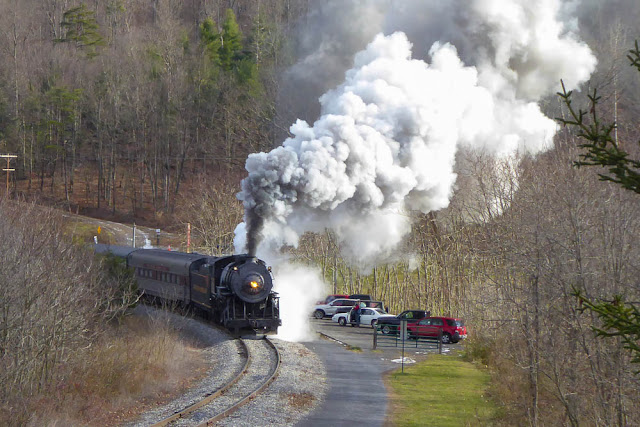 |
| Steam on the road. |
 |
| Mike and I also spent some time at the Cumberland yard location known as 'Mexico'. No idea why it's called that, but the light and the action was interesting. |
 |
| Another departure from Mexico. |
Saturday, February 27, 2016
Thinking About An N Scale Display Layout: The Idea
The Dunes Junction is an HO interpretation of beloved childhood railroading memories, but for as long as I have been involved in model railroading I've had an eye on N scale.
Couple of reasons for this: the first model railroads of which I have any memory are N scale--I think an uncle or older cousin had N scale trains back in the late 60s or early 70s. Among my earliest memories of reading about model railroading are the Clinchfield project railroad articles that ran in Model Railroader magazine in the late 70s. (Here's MR old hand Jim Hediger telling funny stories about the Clinchfield layout.)
I've even owned N scale trains over the years. I started a very tiny, very lightweight N layout while I was stationed in Germany with the US Army. The end of that story is worthy of an episode of the A Modelers Life podcast: I think I ended up trading all that N stuff away for four bald tires or a water pump or some such that I needed for my ancient Mercedes 230.4. Twenty or so years ago I started building another modest N roster, which I subsequently parlayed into a spray booth and airbrush accoutrements for robot and military model building.
This YouTube Thompson River Canyon video catalyzed my latest infatuation with N scale:
The concept is what really got my attention--a manageably-sized, light weight, and visually appealing N scale scenic vignette--scenery in the front, staging/fiddling in the back, simple trackwork. The magazines have shown track plans and concepts like this in the past, but precious few actually built examples.
Seeing this smallish and achievable N scale display layout prompted me to revisit some other smallish N scale layouts of note. I went back and studied namely the Red Oak, Salt Lake Route, and Carolina Central project railroads that ran over the past few years in Model Railroader, Dave Vollmer's Juniata/Pennsy layout, and its inspiration, Lou Sassi's Mohawk Division, also an MR project layout that later appeared in a Kalmbach book on small layouts. The Red Oak, Carolina Central, Juniata, and Mohawk layouts, like the Thompson River Canyon, were all built on a hollow-core doors.
The Juniata and Mohawk layouts showed that a simple double track loop could actually host longish locos and passenger cars against believable scenery, and the internet video of most of these layouts show trains running. With my interest focused lately on the Northeast corridor (see this, this, and this), I immediately made the connection that such a display layout might scratch an itch I've had for a while to somehow 'casually' model Pennsy and post-Pennsy electrics.
Where is this all going? The hollow core door and other benchwork accoutrements have been acquired, as well as a supply of Peco track. I'm thinking this new thing will be called 'The Old Line Corridor' (a Maryland riff on Pennsylvania's Keystone Corridor) and if I do it right, it'll look something like a Mohawk or Juniata Division with catenary.
Wednesday, February 24, 2016
Southwest Chief and Southern California
 |
| My wife and I visited our older son in Southern California over the holidays, and we rode most of the way there on the Amtrak Southwest Chief. It was a glorious ride, though we quickly realized that it would have been a more enjoyable trip on longest, rather than shortest days of the year. Here we are on an extended stop in LaJunta, New Mexico. |
 |
| The front office. |
 |
| Big Western railroading in Cajon. We took a side trip away from my son's home town of Santa Monica to see some of SoCal's famed vistas. |
 |
| UP at Cajon |
 |
| The scale is breathtaking |
Sunday, February 21, 2016
What's Been Happening Around Dunes Junction
 |
| Coming Soon: Southwest Chief Adventure! |
Tuesday, September 15, 2015
First Rides Behind an ACS-64 City Sprinter
 |
| Did an up-and-back trip from Washington, DC to Stamford, CT over the weekend, and this ACS-64 was on the point. It was a smooth and uneventful ride, and my first ever ride behind a City Sprinter |
 |
| Northbound Acela approaches Stamford while waiting for the train to take us home. Dig those tangles of track and catenary! |
 |
| And this ACS-64 got us home, on time and without incident. These locos are growing on me . . . Kato announced one in N scale, maybe an HO version isn't far behind |
Monday, September 7, 2015
Sighted During a DC Brewery Hike: Amtrak's Ivy City Facility
 |
| My wife Rachel and set out on a little urban hike in Washington DC's Ivy City neighborhood to find craft beer and fancy food. Our route took us on an overpass spanning Amtrak's Ivy City facility. Here are two Acelas warming up for runs up the Northeast Corridor later in the afternoon. |
 |
| The whole facility, early in the afternoon. By late afternoon, this staging yard was full of Acelas as well as other trains destined for the NEC and points west. |
 |
| A switcher pushes Amfleet cars into the shops while Acelas await their runs north. |
 |
| More of the staging yard. Note the Superliner cars between the two Acelas on the right. |
 |
| Another view of the staging yard. |
 |
| Northbound Acela on the main line passes the Ivy City facility. |
Subscribe to:
Posts (Atom)